Answer: When you need a reliable all-purpose spackling paste for interior wall repairs, choose products that dry quickly, provide good fill, and are paint-ready without shrinking. The top picks cover fast-drying formulas, color-changing indicators, and versatile use on drywall, plaster, wood, and masonry. This guide highlights five products suited for DIYers and professionals, with each choice explained for its ideal use case and any notable limitations. For most projects, consider a fast-drying paste for small patches and a larger tub for bigger repairs.
| Product | Best For | Key Benefit |
|---|---|---|
| DAP Fast ‘N Final Lightweight Spackling | Quick patches and priming | Ultra-smooth finish with fast dry |
| DAP DryDex Dry Time Indicator Spackling | Visible drying cue | Color-changing pink-to-white indicating dry state |
| DAP Spackling Paste, White 8 Oz | Small cracks and nail holes | Ready-to-use vinyl copolymer paste |
| DAP Spackling Paste, White 32 Oz | Medium to large repairs | Larger volume for extended projects |
| Gorilla High Performance Wall Repair | Color-change + fill | Purple application to white when ready to sand/paint |
DAP Fast ‘N Final Lightweight Spackling, White, 8 Oz

Best For: Quick patches on interior walls where you want to paint soon after filling. Ideal for DIYers and professionals who need a fast, low-odor repair that accepts paint in about 30 minutes. This product combines patching and priming in one step, simplifying small repairs and reducing steps.
What to know: It uses advanced microsphere technology to deliver an ultra-smooth finish with minimal visible patch. A potential limitation is the 8-ounce size, which may require more frequent reapplication on larger jobs.
- Durable spackle suitable for quick patch-and-prime projects
- Ultra-smooth finish that helps hide repairs without altering paint sheen
- Low odor and fast dry time
DAP DryDex Dry Time Indicator Spackling, Pink/White, 32 Oz

Best For: Projects where you want a visible cue that the patch is dry, useful for DIYers and builders who work with varying humidity. DryDex changes color from pink to white as it dries, confirming readiness before painting.
What to know: It’s a latex polymer spackle suitable for interior and exterior repairs on drywall, plaster, wood, brick, and stone. The drying time is user-determined by depth and environment, so larger fills may require multiple layers and drying intervals.
- Color indicator shows when the patch is dry (pink to white)
- Dries within 1 hour for shallow repairs; multiple layers may be needed for deeper fills
- Versatile across multiple substrates
DAP Spackling Paste, White, 8 Oz

Best For: Small repairs on plaster, wallboard, and wood where a ready-to-use paste is preferred. Suitable for beginners who want a straightforward fill and paint workflow without mixing or extensive prep.
What to know: The paste dries in 3–6 hours and accepts oil- or latex-based paints when fully dry. It requires thorough stirring before use, and deeper fills may require multiple applications and longer drying times.
- Ready-to-use vinyl acetate ethylene copolymer paste
- Dries in 3–6 hours; paintable after fully dry
- Stir thoroughly before application
DAP Spackling Paste, White, 32 Oz

Best For: Larger repair jobs where a bigger tub helps reduce frequent re-purchases. Suitable for professional settings or frequent patching on drywall, wood, or plaster.
What to know: Uses vinyl acetate ethylene copolymer paste; ready to use, but deep repairs should be layered. Drying time is generally 3–6 hours depending on conditions, and painting can be done after full dry.
- Large-volume spackling for bigger repairs
- Consistent vinyl copolymer formula for durability
- Requires thorough mixing and layering for deep fills
Gorilla High Performance Wall Repair, 16 oz Tub
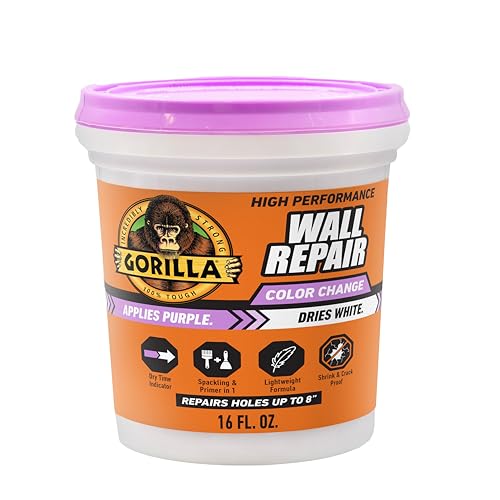
Best For: Repairs where color-change guidance helps ensure proper drying, and where both spackling and primer are desired in one step. Good for small-to-medium holes and patches on drywall and plaster.
What to know: The color-change formula turns purple on application and dries white, allowing predictable sanding and painting. It’s lightweight with a no-sag formulation, which helps control slumping on larger holes. A limitation is that color-change effectiveness may vary with certain surface conditions.
- Color-change to white when dry for easy finishing
- Spackling and primer in one product
- Lightweight and easy to spread
Buying Guide: Key Considerations for All-Purpose Spackling Paste
- Project size and depth: Choose a product that matches the repair scale. Small patches benefit from 8 oz or 16 oz tubs, while larger jobs may require 32 oz containers.
- Drying time and layering: If repairs are deeper than 1/8″, plan for multiple thin layers and drying intervals. Fast-dry options save time but may be less forgiving on large fills.
- Finish and sanding: For a seamless finish, look for formulas that dry smooth and resist shrinking. Some products offer primer-in-one or color-changing cues to simplify finishing.
- Surface compatibility: Most spackling works on drywall, plaster, wood, and masonry. Verify compatibility with your specific substrate to avoid adhesion issues.
- Paint readiness: Determine whether the paste accepts oil- or latex-based paints after drying, and approximate drying times in your environment.
- Odor and ease of use: Low-odor formulas are preferable for indoor spaces and rooms with limited ventilation. Some products are easier to spread and feather for a professional look.
FAQ
- Q: How quickly should I expect spackling to dry before painting? A: Dry times vary by product and depth. Small patches can dry in about an hour to a few hours, while deeper fills may take longer; always follow label directions.
- Q: Do I need to prime over spackling? A: Some products are designed to accept paint directly after drying, while others state that primer is optional or included; check product notes for guidance.
- Q: Can these pastes be used on exterior surfaces? A: Some spackling products are suitable for exterior use; verify the label to ensure it’s designed for exterior or interior applications as needed.
- Q: Is color-changing spackling better than plain paste? A: Color-change aids in seeing when the product is dry; it helps ensure proper finishing but is not a substitute for following drying times.
- Q: What tools are best for applying spackling paste? A: A putty knife or wide knife provides smooth fills; for larger patches, use a taping knife to feather edges.
- Q: Is a larger tub worth it for a small project? A: For recurring repairs or larger walls, a 32 oz tub often reduces re-purchasing, but for a single small patch, a smaller tub is more economical.