As an Amazon Associate I earn from qualifying purchases. Purchases through Amazon links in this guide may earn a commission at no extra cost to you.
A sanding sponge and a hand sander solve different tool-format needs. This comparison pairs a documented four-pack of fine angled 3M sponges with a Warner sheet-holding hand sander, so you can decide whether you need a ready-made foam abrasive or a holder for a separately selected abrasive format.
These conditional picks come from inspected listings rather than hands-on tests. Tool selection comes after deciding whether the proposed surface disturbance is appropriate, especially when old paint or uncertain material may be involved.
Start with the supported preparation task
Read the repair material and coating directions before choosing an abrasive. Identify the stage that needs preparation and the result that stage is supposed to produce.
Do not treat every visible ridge or rough patch as permission to sand. A raised edge, torn facing, unstable coating, and moisture-damaged board can require different assessment or repair decisions before an abrasive belongs in the plan.
If old paint may be disturbed, resolve lead-safe assessment and work planning before proceeding. A hand tool does not make unknown coatings safe.
Keep the work's dust-control and cleanup requirements with the project. Buying a small foam block does not independently establish that the resulting debris can be managed as an ordinary household cleaning task.

3M fine angled sponges for a defined foam-abrasive need
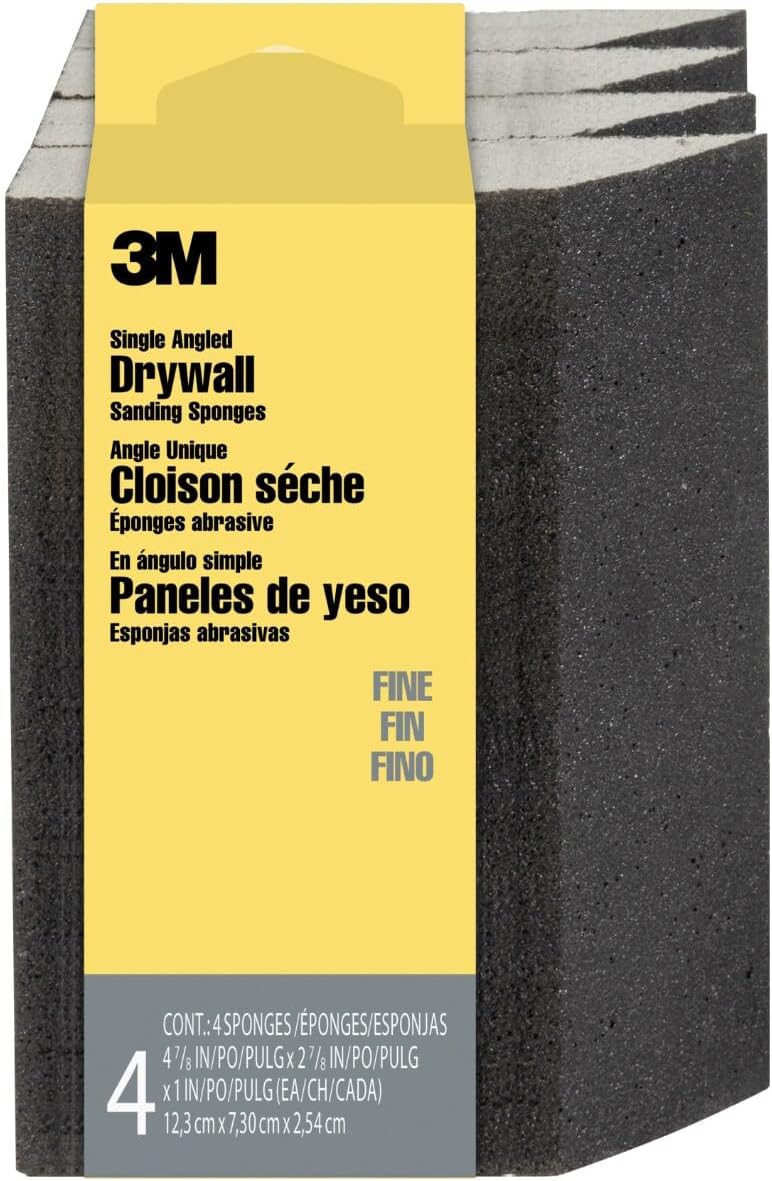 Check Price on Amazon3M single-angle fine sanding sponges, four-count pack
The selected 3M package contains four fine, single-angle sanding sponges. It is a foam-abrasive format with an angled working shape, rather than a holder for a separate sheet.
The listing describes flexible foam and an angled shape for crevices or corners as well as suitable flat or contoured surfaces. Choose this format only where that documented tool role and the actual preparation instructions fit your project.
A shaped foam abrasive presents a different handling choice from a sheet clamped to a broader base. The angle can be relevant to access, but it is not a promise that every corner can be finished without affecting adjacent surfaces.
The word fine is the selected product category, not a numeric grit specification established by this article. Do not translate it into an assumed abrasive number or substitute it for a grit requirement in your repair system.
Four sponges may make sense if you have a defined use for that quantity and can store the unused tools appropriately. It may be more than a single small repair needs, so include the complete package in the purchase decision rather than comparing an imagined one-block price.
The product description permits wet or dry use, but that does not mean either method suits every substrate or coating. Follow the preparation system and tool instructions together instead of choosing a wet method solely to improvise dust control.
Warner 3410497 for a sheet-holding hand-sander format
 Check Price on AmazonWarner 3410497 lightweight plastic hand sander, one tool
The inspected Warner listing identifies model 3410497 as a one-count lightweight plastic hand sander with locking mechanisms and a hand grip. It says the holder supports half of a standard nine-by-eleven-inch sandpaper sheet.
Consider this format when you need a holder for the abrasive specified by the actual preparation method. The holder's construction and sheet format are the reason for the conditional pick, rather than an invented claim that it removes material faster than a sponge.
Keep the abrasive selection separate from the holder purchase. Check the selected package contents and choose the compatible abrasive specified for your wall, because the holder itself does not establish a preparation grit.
A broader sheet-holding base gives you a different physical contact arrangement from an angled foam block. Compare that arrangement with the supported task and the available access rather than assuming that more area is always easier to control.
Before use, follow the holder's instructions for fitting the compatible abrasive and checking its condition. A loose or unsuitable sheet is not a problem you should try to solve by applying more pressure to the wall.
This tool also needs an appropriate care and storage plan. Inspect the base, grip, and locking parts before the next project instead of assuming that a clean-looking handle means the complete setup is ready to use.
| Product | Selected format | Package | Consider when |
|---|---|---|---|
| 3M fine single-angle | Angled foam abrasive; fine category | 4 sponges | A specified fine foam-abrasive task |
| Warner 3410497 | Plastic holder; half 9×11-inch sheet | 1 holder | A task specifying a compatible sheet abrasive |
Keep format and abrasive grade separate
The foam product comes with its selected abrasive category as part of the block. The Warner product supplies a holding format whose actual abrasive choice still needs to match the job and the package you verify.
That distinction prevents a misleading comparison between fine foam and an unspecified sheet. You are not comparing two identical abrasives, so a claim that one must leave a better finish would require evidence this research does not provide.
If a preparation instruction names a grit or particular abrasive type, follow it or obtain suitable advice about an alternative. Do not replace that specification with whichever product happens to be described as drywall sanding equipment.
The same caution applies to the surface itself. A tool suitable for one documented compound or coating stage is not automatically suitable for an unknown painted layer elsewhere in the room.

Compare contact shapes in the actual space
Imagine a small detailed area next to a boundary you need to preserve. Think about where the tool's sides and working face would sit, while leaving the permitted preparation method governed by the material instructions.
Now imagine a clear accessible area whose supported method calls for a sheet abrasive on a holder. That is a different format decision from fitting the angle of a foam block into a narrow detail.
Neither imagined task tells you how much material to remove or how hard to press. Those technique and finish questions depend on the actual system and surface condition, not a general product photograph.
Use the comparison to narrow the shopping question. You can then ask for the tool and abrasive that match a defined operation instead of buying both formats because the wall's appearance remains unexplained.
Do not confuse convenience with dust control
A compact hand tool still needs the appropriate work-area, exposure-control, and cleanup plan for the material involved. Its size does not establish the composition or significance of the debris it can produce.
Keep household access and cleanup responsibilities clear before starting. An abrasive purchase is only one part of the project, and the wall's readiness for paint depends on completing the supported preparation properly.
If the work changes or reveals uncertain material, pause and reassess. Do not expand the disturbed area merely because spare blocks or sheets remain in the package.
This comparison does not supply a sanding procedure or a universal dust-control setup. It helps you choose a documented tool format after those more important project decisions have been resolved.
Check the package before choosing
Choose the 3M four-pack when a fine angled foam format fits the supported task and you have a useful reason to buy that quantity.
Choose the Warner when you need its sheet-holding hand-sander format and can select the appropriate compatible abrasive.
Confirm the selected package and read the current instructions before use. You will have a clear tool-format decision without mistaking a retailer's category name or an unexplained grit field for a complete preparation specification.
Keep unused abrasives identifiable
If you retain spare tools or sheets, keep the product and grade information with them. A loose foam block or an unmarked sheet can be difficult to identify later, and its appearance alone should not become the basis for an assumed substitute on another coating system.
Record which surface and stage the original selection was intended for. You can then revisit the actual instructions when a new repair differs, rather than treating every abrasive in the same drawer as interchangeable material for the next wall.
Inspect the surface at the supported point
Before deciding that another tool is necessary, evaluate the preparation at the stage and under the conditions required by the actual method. A visible difference may concern profile, texture, or another material issue rather than a simple need for a larger abrasive.
Keep that observation specific when seeking advice. Describing where a transition appears and what material remains is more useful than requesting a stronger sanding tool without knowing which condition the proposed change is meant to address.
Published technical information supports the specific material statements. Room examples and illustrations are original; they are not product tests or a diagnosis of your wall.
- Exact final four-count fine angled foam package and one-count sheet-holder format; no numeric grit invented or included-sheet claim. Old-paint assessment boundary retained.
- Exact final four-count fine angled foam package and one-count sheet-holder format; no numeric grit invented or included-sheet claim. Old-paint assessment boundary retained.
- Exact final four-count fine angled foam package and one-count sheet-holder format; no numeric grit invented or included-sheet claim. Old-paint assessment boundary retained.