Yes, water-based primers for walls are a smart choice for most interior projects. They dry quickly, block stains, and provide solid adhesion for topcoats. This guide highlights five top options that fit common needs—from stain blocking and odor control to mold resistance and all-surface performance. Best for DIY projects, rental properties, and fast-track renovations.
| Product | Best For | Key Benefit |
|---|---|---|
| Zinsser Bulls Eye 1-2-3 Water-Base Primer & Sealer | General interior/exterior priming | Sticks to glossy surfaces; low-temperature application |
| Zinsser Bulls Eye Water-Base Primer & Sealer (White) | Drywall, wood, painted surfaces | Low-odor, fast-dry, excellent stain hiding |
| Zinsser 1-2-3 All Surface Primer (Gray) | All-surface applications | Sticks to tough surfaces without sanding |
| Zinsser HIDZ Multi-Purpose Primer | Pigmented hiding on porous surfaces | Hides previous colors and seals porous surfaces |
| Zinsser Mold Killing Primer | Mold-prone interiors | Antimicrobial, blocks mold and odors |
Zinsser Bulls Eye 1-2-3 Water-Base Primer & Sealer, White
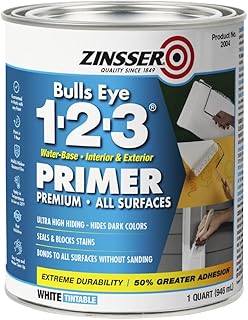
This all-surface primer-sealer is designed for interior and exterior use, providing strong adhesion to glossy surfaces without scuff sanding. Its low-temperature application capability makes it practical for a variety of project conditions. Best for homeowners tackling repainting on previously finished surfaces or new, challenging substrates.
Best for: projects needing a robust bond on glossy surfaces and a fast, simple priming step. The product data emphasize interior/exterior versatility and stain blocking on diverse substrates.
Limitations: as a generalist, it may require a dedicated topcoat choice to optimize finish appearance on certain porous surfaces. Not ideal when ultra-low odor is required for sensitive spaces.
Zinsser Bulls Eye Water-Base Primer & Sealer, White

This white water-based primer-sealer is ideal for priming interior surfaces such as walls, doors, trim, plaster, and concrete. Its low-odor formula provides strong stain hiding, including on dark or porous surfaces, and dries to the touch in about 30 minutes with broad coverage up to 100 sq. ft. per quart.
Best for: indoor projects where odor control matters and quick recoat times help speed up the schedule. It’s especially suitable for spaces with potential stain challenges from previous finishes.
Caution: for heavily stained or water-damaged areas, consider a dedicated stain-blocking primer to ensure full coverage before topcoating.
Zinsser 1-2-3 All Surface Primer, Gray

This gray, all-surface primer is designed for interior and exterior use on new or previously painted drywall, concrete, wood, masonry, metal, and glossy or difficult surfaces. Its water-based formula seals uniformly and sticks without sanding. Dries to the touch in 30 minutes and recoat in 1 hour, covering up to 100 sq. ft.
Best for: projects with varied substrate types where one primer must handle multiple surface challenges. The quick dry and broad compatibility reduce preparation time.
Limitation: while versatile, very glossy surfaces or heavy metal finishes may benefit from light surface preparation for optimal adhesion.
Zinsser HIDZ Multi-Purpose Primer and Sealer

This multi-purpose interior/exterior primer is formulated to hide previous colors and seal porous surfaces. It blocks common stains and dries quickly, enabling a fast topcoat after about an hour. Coverage typically reaches up to 100 sq. ft. per quart.
Best for: homeowners tackling significant color changes, porous substrates, or areas with visible stains from the prior finish. HIDZ is chosen for strong hiding power on difficult surfaces.
Caution: as a multi-purpose product, it may require multiple coats for stubborn color shifts or heavy-duty staining scenarios.
Zinsser Mold Killing Primer, White

This antimicrobial primer is designed to kill existing mold, mildew, and odor-causing bacteria on interior surfaces. It is an EPA-registered fungicidal product that provides a protective coating under any topcoat and helps cover fungal stains.
Best for: spaces prone to moisture, such as bathrooms, basements, or basements with humidity concerns where mold growth is a factor. It pairs well with a mold-resistant topcoat for ongoing protection.
Limitation: antimicrobial protection does not replace proper moisture control and ventilation. Ensure source moisture is addressed for long-term results.
Buying Guide: Practical Decisions For Your Water Based Primer Choice
- Surface Type and Condition: For glossy or hard-to-stick surfaces, select a primer that advertises excellent adhesion without heavy sanding. All-surface options simplify mixed substrate projects.
- Odor and Drying Time: If odor is a concern in living spaces, opt for low-odor or no-odor formulas and note the recoat window and dry-to-touch times for scheduling.
- Stain Blocking Power: For stubborn stains, choose dedicated stain-blocking primers or products that explicitly state stain coverage on dark or porous areas.
- Mold and Mildew Considerations: In moisture-prone rooms, consider primers with antimicrobial properties or that are designed for mold resistance, complemented by humidity control.
- Topcoat Compatibility: Check the topcoat requirements. Most water-based primers pair with latex or acrylic topcoats, but ensure compatibility with your chosen finish.
- Project Timeline: If you need fast completion, prioritize products with quick drying and recoat times, especially when painting multiple rooms in one weekend.
- Application Conditions: Some formulas tolerate lower application temperatures. If painting in cooler spaces, confirm minimum application temperature to avoid poor cure.
Frequently Asked Questions
- Are water-based primers suitable for exterior use? Yes, some water-based primers are designed for interior and exterior surfaces and can provide durable adhesion on various substrates.
- Do these primers seal stains effectively? Many options are stain-blocking and seal porous surfaces, though the level of stain coverage varies by product.
- Can I repaint soon after priming? Most water-based primers allow recoat in about 1 hour (interior), but follow product-specific guidelines for best results.
- Will priming prevent mold growth? Primers with antimicrobial properties help in mold-prone areas, but moisture control remains essential for long-term mold prevention.
- Do I need to sand between coats? Many water-based primers claim excellent adhesion without sanding, but light scuffing on glossy surfaces can improve topcoat grip.
- Which primer is best for porous surfaces? HIDZ Multi-Purpose and other all-surface primers are designed to seal porous materials effectively before topcoating.