The best tile trim for a window depends on whether you need a narrow decorative line, a flexible strip for a curved edge, or a shaped profile to finish a thin tile edge. The JSIWOTH trim is a practical choice for window frames and longer runs; Risunpet suits small seams; and Tilingview offers a grooved profile for thin tile edges. These peel-and-stick products are intended for smooth surfaces, so check the surface, dimensions, and exposure conditions before choosing.
| Product | Best for | Key distinction |
|---|---|---|
| JSIWOTH 20-Foot Trim | Fine window-frame details | Narrow, flexible, paintable |
| Risunpet Quarter Round | Small seams and sill edges | Quarter-round profile |
| Tilingview Tile Trim | Thin tile edges | Grooved, stone-look PVC pieces |
| Art3d Flexible Molding | Decorative tile borders | Flexible, water-resistant PVC |
| JSIWOTH 40-Foot Trim | Long or multiple trim runs | Longer version of narrow trim |
JSIWOTH 20-Foot Flexible Trim

Best for: A slim, decorative finish around a window frame or along a tile border where a pencil-width line is enough. This trim measures 0.25 inches wide, 0.04 inches thick, and 20 feet long. Its small profile is useful when a wider molding would look bulky beside narrow tile or trim.
The product has an acrylic adhesive backing and is described as water-resistant. It is designed to adhere to smooth surfaces such as tile, glass, metal, and wood, and can follow lightly curved edges. The listing also describes it as paintable, which may help when matching the trim to nearby décor.
Why it was selected: The product listing explicitly names window frames and tile edges among its uses, making it a direct match for this search. It offers a long continuous roll for a detailed finish.
Limitation: At only 0.25 inches wide, it is not intended to cover a broad gap or provide a prominent border. The listing recommends warming the adhesive briefly in cold conditions.
Risunpet Mini Quarter-Round Trim

Best for: Finishing a narrow seam at a window sill, countertop, desk, cabinet, or similar edge. The listed profile is 0.25 inches wide by 0.25 inches high, with 10 feet supplied. Its quarter-round shape provides a different look from flat, pencil-width molding.
Installation is described as a simple peel-and-stick process: measure the run, cut the trim, remove the backing, and press it onto a clean, dry, smooth surface. The listing says no nails, screws, or specialized installation tools are required. Its compact dimensions are intended for small seams rather than large gaps.
Why it was selected: The product specifically names windows and window sills as possible applications. It is a better fit than a wider molding when the goal is a subtle edge finish.
Limitation: The manufacturer describes this as a low-profile trim for narrow gaps, not a solution for wide openings or replacing larger molding. Confirm that the seam is small enough for its dimensions.
Tilingview Grooved Tile-Edge Trim

Best for: Finishing the exposed edge of thin tile around a window or other tiled feature. Each PVC piece measures 12 inches long, 0.5 inches wide, and 0.33 inches high; the package contains 10 pieces. A groove is designed to fit over a tile edge, while the white-stone color has light gray veining.
The pieces use self-adhesive backing and are intended for edge finishing on thin tiles, including self-adhesive tile. The listing also identifies mirrors, accent walls, countertops, and picture frames as uses. The stone-look appearance may coordinate with light-colored tile, but it is visually more distinct than plain white trim.
Why it was selected: Unlike a flat molding strip, this product has a grooved profile specifically intended to sit at a tile edge. It may suit a tiled window surround where the tile thickness and profile match.
Limitation: The pieces are only 12 inches long, so a longer run requires multiple sections and careful alignment. Check the groove and dimensions against the tile before buying.
Art3d Flexible PVC Molding Trim
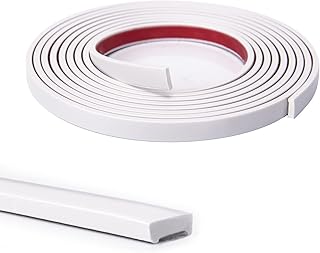
Best for: Adding a flexible decorative border to tile edges, backsplash tile, or mirror edges. The product is a 10-foot white strip made from PVC. Its listed features include peel-and-stick installation, the ability to cut it with scissors, and flexibility for fitting corners.
Art3d describes the trim as water-resistant and oil-resistant, with an adhesive backing. The listed uses include framing or decorating backsplash tiles and finishing mirror edges. These details make it a reasonable option for indoor decorative tile work where a flexible strip is more useful than rigid pieces.
Why it was selected: Its flexible construction and stated tile-edge use make it relevant to window tile surrounds, particularly where the trim needs to follow a corner or a less-than-straight detail.
Limitation: The supplied information does not give the strip’s width or height. Measure the intended edge and compare it with the product details before relying on it to cover a specific gap.
JSIWOTH 40-Foot Flexible Trim

Best for: Long window-frame runs or several trim details that need the same narrow profile. This version measures 0.25 inches wide and 0.04 inches thick, with 40 feet in the roll. It is described as flexible, paintable, and suitable for smooth surfaces including tile, marble, glass, metal, and wood.
Its acrylic adhesive backing is described as water-resistant. The listing includes window frames and backsplash tile among its intended applications and says the trim can cover small gaps or edge imperfections. The same narrow profile makes it suitable for subtle finishing rather than a broad decorative band.
Why it was selected: It offers the same stated dimensions and application range as the 20-foot version, but provides twice the listed length. Choose it when a project has many edges or a longer continuous run.
Limitation: The 0.25-inch width may not provide enough visual coverage for a large gap. The listing advises briefly warming the adhesive in cold temperatures before application.
Buying Guide: How to Choose Tile Trim for a Window
What type of edge are you finishing?
Start by identifying whether the trim will cover the exposed edge of a tile, finish a small seam, or create a decorative line around a window. A grooved profile such as the Tilingview pieces is designed for thin tile edges. A narrow flat strip is better suited to a subtle border or fine decorative detail. A quarter-round profile can soften the appearance of a small joint.
Do not choose by appearance alone. The product’s shape and measurements determine what it can cover. Compare the profile to the tile thickness and the width of the opening. If the gap is wider than the trim, the product may not conceal it.
How should you compare trim dimensions?
Check width, height, thickness, and total length. Width and height affect how much of the edge the trim can cover and how prominent it appears. Length indicates how many joints or window sides a package may cover, but corners, cuts, and alignment can affect actual use.
The two JSIWOTH options are both 0.25 inches wide and 0.04 inches thick, with 20- and 40-foot lengths. Risunpet is a 0.25-inch-by-0.25-inch quarter round. Tilingview supplies ten 12-inch pieces with a grooved profile. These are different formats, not interchangeable profiles.
Will peel-and-stick trim adhere to the surface?
These products generally call for a clean, dry, smooth surface. Check the surface material and prepare it according to the product directions before application. Dust, moisture, texture, or residue can interfere with contact between adhesive and surface. The JSIWOTH listing names tile, glass, metal, marble, and wood, while other products provide their own surface or use details.
For JSIWOTH trim, the listing notes that cold temperatures can affect stickiness and suggests briefly warming the adhesive with a hairdryer. Follow the manufacturer’s instructions and avoid assuming that peel-and-stick adhesive will perform equally on every finish.
Is the trim suitable for a wet or exterior window?
Some listings describe their trim as water-resistant or suitable for indoor kitchen and bathroom use. Water resistance should not automatically be interpreted as waterproofing, a substitute for tile installation materials, or proof of suitability for an exterior window. The supplied product information does not establish that these options are designed for outdoor exposure or to seal a window against weather.
For a window that faces rain or experiences frequent direct water exposure, verify the product’s intended use and installation requirements before purchase. Use an appropriate sealing system where the project requires one; decorative trim alone should not be treated as a window seal.
Should you use a continuous roll or separate pieces?
A roll can make long, simple lines easier to lay out with fewer visible joints. The 20- and 40-foot JSIWOTH rolls and the 10-foot Art3d strip suit projects where continuous flexible trim is useful. The Tilingview set uses individual 12-inch sections, which may work well for short tile edges but requires more attention to joins.
Measure each side of the window and plan where cuts and joints will fall. For corners, check whether the selected strip can bend to the required shape or whether it must be cut and joined. Product descriptions do not provide a universal corner method, so consult the installation directions for the specific trim.
Which color and finish will look right?
White trim is a common choice for light window frames and tile, but shades and finishes can differ. Tilingview is described as white stone with light gray veins, while the other listed options are white. The JSIWOTH trim is described as paintable. If color matching is important, compare the product’s current appearance with the tile and frame before installing a full run.
What should you do before installation?
- Measure the window perimeter and the exposed tile edge.
- Compare the trim profile and dimensions with the tile and gap.
- Confirm that the intended surface is smooth, clean, and dry.
- Plan cuts and joints before removing adhesive backing.
- Check the product instructions for temperature and surface guidance.
- Test the appearance and fit in a discreet area when practical.
Frequently Asked Questions
What is the best trim for a narrow seam around a window?
A low-profile option such as the Risunpet quarter-round trim is intended for small seams and specifically lists windows and window sills. Check that the 0.25-inch-by-0.25-inch profile is large enough for the seam.
Which option is designed for the edge of thin tile?
The Tilingview trim has a groove intended to fit a thin tile edge. Compare the groove and piece dimensions with the tile before choosing it for a window surround.
Can peel-and-stick trim follow a curved window detail?
The JSIWOTH trim is described as suitable for lightly curved surfaces, and Art3d describes its strip as flexible. The products may suit gentle curves, but the supplied information does not establish how tightly either can bend.
Can I paint the trim?
The JSIWOTH 20-foot and 40-foot listings describe the trim as paintable. The supplied information does not make that claim for the other products. Follow the product instructions and confirm paint suitability before applying a coating.
Does water-resistant mean the trim waterproofs a window?
No. A water-resistant description does not establish that decorative trim seals a window or replaces a waterproofing system. Use products intended for the specific sealing requirements of the project.
How much trim should I buy?
Measure the edges you plan to cover, add allowance for cuts and layout, then compare the total with the listed roll length or piece count. For segmented trim, account for the length of each piece and the joints between sections.


