Answering the question, these spray primers are ideal for drywall: fast-drying, easy to apply, and designed to seal stains, block tannins, and improve paint adhesion. The top picks here are best for indoor walls, new drywall, or patched surfaces where speed and even coverage matter. Choose by surface type, odor tolerance, and whether you need stain blocking or bonding in one step. The buyer’s guide below helps you compare, while the brief product table highlights key options.
| Product | Best For | Key Benefit |
|---|---|---|
| Zinsser 272479 Bulls Eye 1-2-3 Plus Spray Primer | New drywall and tough surfaces | Fast-drying, sticks to glossy surfaces without sanding |
| Rust-Oleum 334019 Painter’s Touch 2X Ultra Cover Primer Spray | Interior/exterior, multiple substrates | Low odor, long-lasting protection |
| 1 Quart Bulls Eye 1-2-3 Primer Sealer Stain Killer | Interior/exterior with staining | Seals and bonds without scuff sanding |
| Zinsser Peel Stop Triple Thick | Peeling or weathered surfaces | Stops peeling, smooths finish |
| Zinsser 3608 Cover Stain | Dark colors and tannin-heavy surfaces | Hides colors, blocks stains, no sanding required |
Zinsser Bulls Eye 1-2-3 Plus Spray Primer
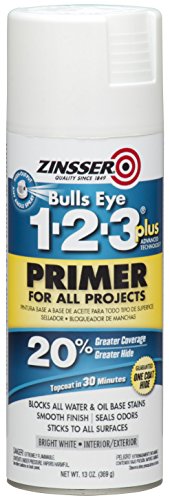
Best for: Interior and exterior applications on new or previously painted drywall, concrete, wood, masonry, metal, and glossy surfaces. This oil-based formula seals uniformly and adheres without sanding. It dries to the touch in about 30 minutes and covers up to 12 sq ft per can, making it a strong all-around primer for drywall patches and smooth fills. Caution: oil-based products can have higher odor and require ventilation. Choose this if you need robust adhesion on challenging surfaces.
Rust-Oleum Painter’s Touch 2X Ultra Cover Primer Spray

Best for: A versatile option for interior and exterior surfaces, including wood, plastic, plaster, metal, masonry, and unglazed ceramic. The oil-based formula is low odor, resists chips, and provides long-lasting protection. It dries to touch in about 20 minutes and covers up to 12 sq ft per can. Use this when you need a quick, broad-coverage primer that works on multiple materials. Caution: can be slightly more textured than water-based variants; test on delicate surfaces first.
1 Quart Bulls Eye 1-2-3 Primer Sealer Stain Killer

Best for: Interiors and exteriors requiring stain sealing and bonding on glossy surfaces without extensive sanding. This product emphasizes strong bonding and performs well at lower application temperatures, making it suitable for rooms with variable temperatures. Limitation: being a 1-quart size, larger projects may need multiple cans for full coverage. Choose this if you want a reliable sealer that reduces tannin bleed and staining issues.
Zinsser Peel Stop Triple Thick

Best for: Stopping peeling paint and sealing weathered surfaces. This high-build binding primer provides a smooth finish and is particularly useful on surfaces with existing peeling paint. Caution: it’s more of a repair primer than a light-use sealer. Use when the goal is to stabilize flaking areas before painting. Not ideal for ultra-fast projects requiring minimal rework.
Zinsser 3608 Cover Stain

Best for: Encounters with dark colors and tannin-heavy surfaces. This oil-based spray primer offers hiding power indoors and out, blocks stains, and improves adhesion without sanding. It’s particularly effective when you need to cover up bold colors under a new finish. Caution: oil-based formulas may require longer cure times for certain surfaces; plan for additional drying time in high-humidity conditions.
Buying Guide: Key Considerations For Spray Primers On Drywall
Surface type and condition: New drywall, patched areas, and previously painted surfaces respond differently. Bonding primers may skip sanding on glossy or slick surfaces, while stain-blocking primers handle tannins from wood or drywall paper.
Drying time and curing: If speed matters, choose primers with quick-to-touch formulas. For rooms with limited ventilation, consider low-odor water-based options, understanding they may require more coats for full coverage.
Odor and ventilation: Oil-based primers usually emit stronger fumes. Use in well-ventilated spaces or choose low-odor water-based variants when possible. Choose this based on occupant sensitivity and room use.
Coverage and cleanup: Coverage per can varies; plan for your project size and order extra for weather-related touch-ups. Water-based formulations simplify cleanup with soap and water, while oil-based primers need mineral spirits or dedicated cleaners.
Stain blocking vs. bonding: If tannin bleed or color bleed is a concern, select a stain-blocking primer. For glossy surfaces or high-adhesion needs, a bonding primer can save sanding time.
Fast Facts: Quick Comparison At A Glance
- Best overall for drywall adhesion: Bulls Eye 1-2-3 Plus (oil-based, fast-dry)
- Best for multi-material projects: Painter’s Touch 2X Ultra Cover (low odor, broad substrate compatibility)
- Best stain control: Cover Stain and Peel Stop variants
- Best for tannin-heavy surfaces: Cover Stain, 3608
FAQ
- Q: Do I need to sand drywall before applying a spray primer? A: Many primers are designed to stick to smooth, lightly dusted surfaces. Bonding primers may allow skipping sanding on glossy or sealed surfaces, but light scuffing can improve adhesion on rough or patched drywall.
- Q: How long should I wait between primer and paint? A: Dry-to-touch times vary by product; most spray primers dry within 20–30 minutes, but full cure may take longer. Follow the label for recoat timing.
- Q: Can I use spray primer on drywall mud patches? A: Yes, especially primers designed for bonding and sealing. Ensure patches are dry and lightly sand the patched areas if needed for better sealing.
- Q: Is oil-based primer safe for indoor use? A: It can be effective, but it has stronger odor and longer cleanup times. Use in well-ventilated spaces and consider water-based alternatives when odor is a concern.
- Q: Which primer should I choose for a quick DIY wall project? A: For speed and broad coverage, Painter’s Touch 2X Ultra Cover Primer offers fast drying and broad substrate compatibility; pairing with a matching topcoat speeds up results.
- Q: Do primers block tannins from drywall or wood? A: Some primers are designed to block tannin bleed, particularly the stain-blocking and Cover Stain variants. If tannins are a concern, choose a dedicated stain-blocking primer.