Answering the question of how to prime new plaster effectively, these primers are designed to seal, bond, and prepare plastered surfaces for paint. The top picks are ideal for interior and exterior projects, offering adhesion to glossy and porous plasters alike. This guide highlights buyers who want fast-drying, low-odor options, and those seeking durable, long-lasting results on fresh plaster. A quick summary table follows to compare the five selected products at a glance.
| Product | Best For | Key Benefit |
|---|---|---|
| Zinsser Bulls Eye 1-2-3 | General interior/exterior plaster | Sticks to glossy surfaces, low-temperature application |
| Meoded Quartz Primer | Venetian, lime, and plaster textures | Single-layer, fast-drying |
| Polar Clear Binding Primer | Damaged, porous plaster | High adhesion, low VOC |
| Meoded Lime Wash Base Coat | Lime-wash-ready surfaces | Base coat for lime-based finishes |
| Zinsser Peel Stop Triple Thick | Peeling or weathered plaster | High-build, binding |
Zinsser Bulls Eye 1-2-3 Water-Base Primer & Sealer
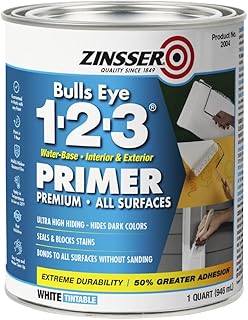
Best for: Projects requiring a universal primer that adheres to multiple surfaces with minimal sanding. This product is suitable for beginners and seasoned pros who want a reliable all-surface sealant for both interior and exterior plaster, drywall, wood, and metal. It bonds to glossy surfaces without scuff sanding and tolerates low-temperature application down to 35°F, providing a solid base for topcoats. It’s a good choice when fast coverage and low prep effort are priorities.
Why it’s selected: The Bulls Eye 1-2-3 is known for its versatility and stain-blocking properties. It provides an even foundation across diverse substrates, reducing the risk of future adhesion issues. The ability to apply over slick plaster without extensive abrasion helps keep the project on schedule.
Limitation: Some projects may still benefit from light scuffing on very glossy finishes for optimal mechanical bonding, especially in high-traffic areas.
Meoded Paint & Plaster Quartz Primer

Best for: Surfaces prepared for Venetian, lime, or decorative plasters, especially when a fast-drying, water-based primer is desired. This option suits interior projects where Meoded plasters or similar textures will be finished with lime or decorative plasters.
Why it’s selected: The primer is designed to work with Meoded plasters and similar textures, offering a single-layer application approach that speeds up the project while providing a stable base for subsequent lime or plaster finishes. Its 100% acrylic composition supports durable adhesion for textured surfaces.
Limitation: As a specialty primer, it may not be the best fit for non-Meoded plaster systems; for those, a more general-purpose primer could be preferable.
Meoded Lime Wash Base Coat Primer

Best for: New plaster surfaces prepared for lime wash finishes, especially when a mineral-based primer is desired. This product is ideal for both interior and exterior lime wash applications where a stable base coat is needed.
Why it’s selected: It acts as a base coat that primes the substrate for lime wash application, ensuring proper adhesion and color performance. The primer is designed to work in tandem with lime-based finishes and provides guidance on surface preparation for best results.
Limitation: Requires a clean, smooth, dust-free surface and may necessitate specific follow-up steps (such as two coats of lime wash) to achieve the desired look and durability.
Zinsser Peel Stop Triple Thick Primer

Best for: Plaster surfaces that have peeling, cracking, or weathered paint issues and need a thick, binding primer to stabilize the substrate before topcoats are applied. A strong choice for restoration projects or repairs on imperfect plaster.
Why it’s selected: It provides a high-build, binding film that seals and binds problem surfaces, reducing further peeling and creating a uniform base for subsequent coatings. This makes it effective for surfaces with prior damage or heavy distress.
Limitation: The triple-thick nature may require longer drying times and careful application to avoid runs on very vertical surfaces or highly textured plaster.
Buying Guide: Key Considerations For Plaster Primers
- Surface compatibility: Choose primers that specifically mention plaster, lime plaster, or decorative plaster to ensure proper bonding with the substrate.
- Interior vs exterior: For exterior plaster, select primers with proven weather resistance and low water permeability to protect against moisture.
- Adhesion to glossy surfaces: If your plaster has a gloss or sealer, pick a bonding primer designed to stick without heavy sanding.
- VOC content: Low-VOC and breathable primers help maintain indoor air quality and moisture movement, especially in tight spaces.
- One or multiple coats: Some plasters benefit from one-coat primers, while others may need a second pass for uniform coverage and sealing.
- Final topcoat compatibility: Ensure the primer is compatible with your intended paint or plaster finish to maximize durability and color performance.
- Drying time and temperature: Consider environments with temperature fluctuations; low-temperature primers can extend workable time in cooler spaces.
Practical Comparisons
- Best overall versatility: Zinsser Bulls Eye 1-2-3 for mixed surfaces and interior/exterior projects.
- Best for lime and decorative plasters: Meoded Quartz Primer and Lime Wash Base Coat for lime-based finishes.
- Best for damaged plaster: Polar Clear Binding Primer offers strong adhesion and stabilization.
- Best for weathered plaster: Zinsser Peel Stop Triple Thick provides high-build binding for problematic surfaces.
Frequently Asked Questions
- What primer should I use on new plaster? — A high-adhesion, interior/exterior primer that bonds well to plaster, seals porous surfaces, and accepts topcoats evenly.
- Can I use a standard drywall primer on plaster? — It depends on the plaster type; some drywall primers work, but primers designed for plaster or lime finishes are typically more reliable for adhesion and durability.
- Do I need to sand before priming plaster? — Light sanding helps, especially on glossy or very smooth surfaces. However, many primers can bond with minimal abrasion, saving time.
- Are low-VOC primers suitable for plaster? — Yes, low-VOC primers are suitable and offer better indoor air quality, particularly in living spaces or offices.
- How many coats of primer are needed for plaster? — Most projects require one to two coats, depending on surface porosity, previous coatings, and the primer’s coverage.
- Should I prime before lime wash or decorative plaster finishes? — Yes. Priming creates a stable base and improves the uniformity and longevity of lime wash applications.