Answering the question: which hand held sanders for wood deliver smooth finishes on a budget and in tight spaces? This guide highlights five top options, each best suited for different buyers—DIY homeowners, hobbyists, and pros needing clean dust control, easy sheet changes, or compact form factors. The products below are selected for versatility, dust management, and ease of use, helping you choose the right sander for finish work, trim, or detailed sanding tasks. A quick summary table follows the intro to compare core features at a glance.
| Product | Best For | Key Benefit | Limitations |
|---|---|---|---|
| SKIL SR211601 | General sanding and finishing | Powerful motor and cyclone dust box | Limited to 5” pads |
| SKIL SR232301 | Detail work and small surfaces | Four-in-one versatility with attachments | Compact form factor may limit aggressive stock removal |
| HYCHIKA Detail Sander | Tight spaces and precision work | 14,000 OPM with multiple sandpapers | Dust collection is secondary to performance |
| SKIL SR250801 | Detail sanding with dust control | Includes 3 sanding papers and dust box | Motor roughly 1 amp, best for light to mid tasks |
| DEWALT DWE6421K | Pro-grade framing and finish work | High performance 12,000 OPM with vibration reduction | Higher price point |
SKIL 5” Random Orbital Sander SR211601

The SKIL SR211601 is a 5-inch random orbital sander powered by a 2.8-amp motor delivering up to 13,000 orbits per minute. It features an easy-to-clean cyclone dust box and an X-flow dust collector, helping maintain a cleaner work area. Variable speed control enables tuning for softwoods, hardwoods, or finishes. Best for wood projects that require fast material removal with workable dust management and straightforward sheet changes.
Best for: DIYers and hobbyists who need a robust sander for general prep, finish work, and trimming tasks. Why: strong motor, comfortable grip, and convenient dust containment support longer sessions without frequent cleanup interruptions. Limitation: 5-inch pads offer limited reach on large surfaces compared with larger orbital sanders.
SKIL Corded Multi-Function Detail Sander SR232301
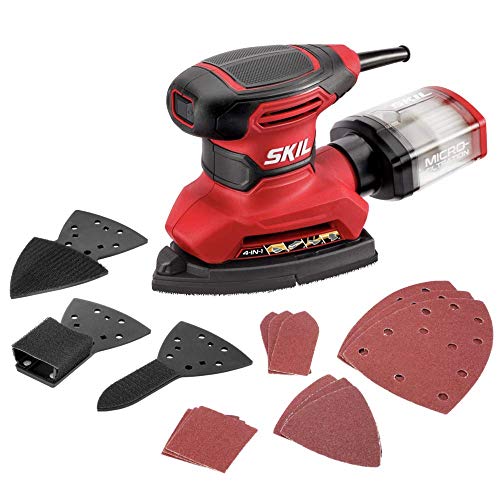
The SR232301 is a 4-in-1 detail sander that adds three attachments for finishing contours, corners, and edges. It includes a micro-filter dust box and a 1-1/4″ dust port for vacuum connections to suit a larger dust-collection approach when needed. Variable detail tools allow precise work, including tight radii. Best for: intricate projects, corners, and edges where precision matters. Limitation: smaller ergonomic footprint can be less comfortable for long heavy sanding sessions.
HYCHIKA Detail Sander

The HYCHIKA Detail Sander operates at up to 14,000 OPM with a compact 1.6-amp motor, making it suitable for tiny corners, paint removal, and rust stripping on metal surfaces as well as wood finishing. Includes 12 sheets of sanding paper (P80, P120, P240) and straightforward hook-and-loop attachments. Best for: users who need a lightweight, precise tool for small areas. Limitation: may run hotter during extended use and dust collection is secondary to speed.
SKIL Corded Detail Sander SR250801
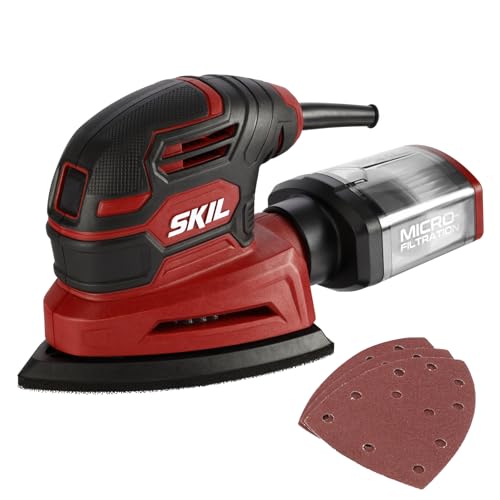
The SR250801 is a corded detail sander with a 1-amp motor and 12,000 orbits per minute. It features a hook-and-loop sanding sheet change system for quick swaps and a micro-filtration dust system with a 1-1/4” dust port for vacuum attachment. Best for: tight spaces and detailed finish work requiring fast sheet changes. Limitation: lighter motor power means slower material removal on hard, dense woods.
DEWALT Orbital Sander Kit, 5 inch (DWE6421K)
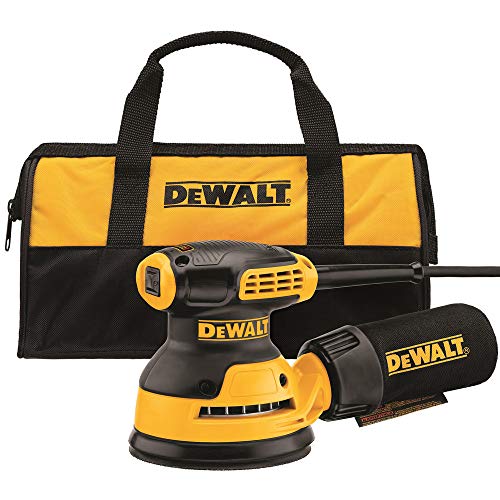
The DEWALT DWE6421K offers a 3-amp motor delivering 12,000 OPM with a shorter height to reach closer to the workpiece. A separate counterweight design reduces vibration for improved comfort during longer sessions. Best for: professionals and serious hobbyists who need consistent performance and reduced fatigue. Limitation: higher price point and heavier compared with entry-level models.
Buying Guide: Key Purchase Considerations
What sanding task will you tackle? For light finishing and trim work, a compact detail sander with good dust control can be ideal. For general surface prep, a mid-size orbital sander with a robust dust system and variable speed helps balance material removal and finish quality. For tight corners or irregular surfaces, a multi-function detail sander with interchangeable attachments adds versatility. Always consider pad size, motor power, dust collection, and ease of sheet changes when comparing models.
Dust management matters. If you plan long sessions or messy projects, prioritize a model with a cyclonic or micro-filtration dust system and a dust port compatible with your shop vacuum. Comfort features like low-vibration design, balanced weight, and ergonomic grips influence control and accuracy on detailed work.
Ease of use and maintenance affect long-term performance. Saws with hook-and-loop paper changes and dust bags or integrated dust boxes reduce downtime. Look for compatibility with common sanding grits (P80–P240) and whether the tool accepts standard 5-inch or 6-inch sheets depending on the pad size.
Frequently Asked Questions
- Which hand held sander is best for beginners? A compact detail or random orbit sander with a user-friendly dust system and easy paper changes is typically best for beginners, offering forgiving control and quick setup.
- What pad size should I choose for wood finishing? A 5-inch pad is common for most wood finishing tasks, providing a balance of material removal and surface finish on standard boards.
- Is dust collection essential for sanding indoors? Yes. A good dust collection system minimizes airborne dust and improves visibility and cleanliness in the workspace.
- Do I need variable speed on a sander? Yes, especially when switching between softwoods and hardwoods or when varying the finish quality you need. It helps prevent burn marks and chatter.
- Can I use these sanders on metal or plastic? Some models support metal or plastic finishing at low speeds, but most are optimized for wood; check motor power and attachments for compatibility.
- What is the advantage of a micro-filter dust box? Micro-filtration helps capture finer dust particles, improving air quality and reducing clogging in the dust canister.