Answer: For exterior concrete wall coatings, choose products that provide durable water resistance, crack-bridging ability, and long-term protection against moisture and weathering. This guide highlights five suitable options and explains who each is best for, with practical buying considerations and a concise comparison table to aid decision-making.
Quick comparison at a glance: the table below summarizes the five selected products, focusing on best use, surface compatibility, and key strengths. Use it to narrow down choices before reading detailed sections.
| Product | Best For | Surface | Key Benefit |
|---|---|---|---|
| Ames Block & Wall Liquid Rubber | Basements, foundations, and dark, damp walls | Concrete, masonry | Flexible waterproof membrane |
| KILZ Basement & Masonry Waterproofing Paint | Interior and exterior masonry with water pressure | Concrete, brick, stucco | Nanotechnology water barrier |
| Classic Coatings Water-Based Sealer | DIY projects, patios, masonry | Concrete, brick, masonry | Water repellant with UV stability |
| Liquid Rubber Basement & Foundation Sealant | Active leaks, basements, foundations | Concrete, masonry | 900% elongation for flexibility |
| KILZ Decorative Concrete Coating | Grey stone-like finish for outdoor surfaces | Concrete, masonry | Textured, crack-bridging finish |
Ames Block & Wall Liquid Rubber Waterproofer
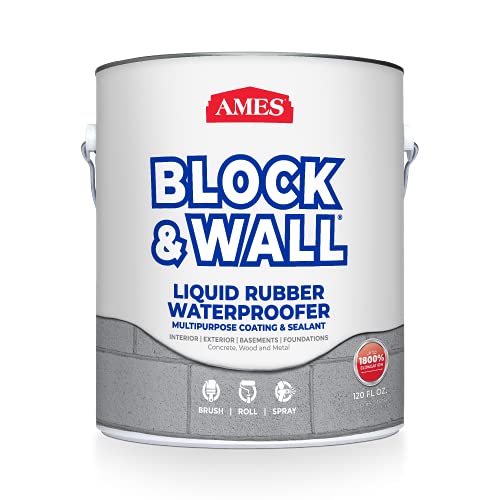
Ames Block & Wall Liquid Rubber is designed as a versatile waterproofing membrane for concrete and masonry. This product is best for basements and foundations where a flexible sealant is needed to prevent water intrusion. It provides a durable, continuous coating that moves with the substrate, reducing crack-related leaks.
Who this is best for: homeowners or property managers seeking a straightforward, single-component waterproofing solution for below-grade walls or damp exterior sections. It’s suitable where a white coating is desired and where base materials include concrete or masonry.
Why selected: it offers a professional-grade waterproof membrane without complex mixing, enabling straightforward application. The included characteristics emphasize moisture resistance on concrete and foundation surfaces.
Caution: the product’s weight and consistency may require proper surface preparation and weather window for best adhesion. Avoid applying on actively leaking surfaces without additional crack repair steps.
KILZ Basement and Masonry Waterproofing Paint

KILZ Basement and Masonry Waterproofing Paint combines a water barrier with interior/exterior versatility. Engineered to block up to 12 PSI of water pressure, it helps prevent infiltration on concrete, brick, and masonry surfaces. It is suitable for below-grade use after proper crack filling with hydraulic cement.
Who this is best for: homeowners tackling damp basement walls or outdoor masonry surfaces where a paintable, protective coating is desired. It suits projects needing a paint-like finish with robust water resistance.
Why selected: this option balances waterproofing with paintability, offering a barrier while allowing color and finish options. It is particularly useful where both protection and aesthetics matter.
Caution: not intended for walls with active leaks or floors, and ensure proper surface preparation for best adhesion in moist conditions.
Classic Coatings Water-Based Sealer

Classic Coatings Water-Based Sealer is a versatile, ready-to-use sealant appropriate for interior and exterior surfaces, including concrete, brick, masonry, and stone. It enhances color and provides water repellence, with quick drying and UV stability. It is designed for simple DIY applications with broad surface compatibility.
Who this is best for: DIYers seeking an economical, easy-to-apply sealer that improves color depth and provides moisture resistance on patios, driveways, and masonry walls.
Why selected: its wide surface compatibility and user-friendly application make it a practical choice for projects that require a fast-drying, protective finish without specialized equipment.
Caution: coverage varies by surface porosity; ensure adequate cleaning and surface prep to achieve uniform results.
Liquid Rubber Basement & Foundation Sealant

Liquid Rubber Sealant delivers a flexible, waterproof membrane designed for basement waterproofing and foundation leak repair. With 900% elongation, it adapts to substrate movement and remains well-suited for crack-filled areas, showers, and containers where moisture is a concern.
Who this is best for: homeowners dealing with active leaks or areas requiring a resilient, flexible coating that stays pliable across temperature changes.
Why selected: its high elongation and wide substrate adhesion make it a strong choice for critical waterproofing tasks beyond simple coatings. It provides a durable barrier in wet environments.
Caution: while flexible, ensure surface preparation is adequate and note that multiple coats or additional structural repairs may be necessary for extreme conditions.
KILZ Decorative Concrete Coating

KILZ Decorative Concrete Coating offers a slip-resistant, gray, stone-like finish with UV stability suitable for walls, patios, garages, and pool decks. It fills cracks up to a point and resists hot tire pick-up, providing a durable, decorative exterior finish.
Who this is best for: homeowners wanting a textured, aesthetically pleasing finish that also provides protection against wear, UV exposure, and moisture on outdoor concrete surfaces.
Why selected: it combines decorative texture with performance, delivering a robust exterior coating that hides imperfections and resists common outdoor stressors.
Buying Guide: Exterior Concrete Wall Coatings That Stand Up To Weather
What should you consider before buying?
Surface type, climate, and exposure level drive the best choice. For below-grade walls or damp basements, consider flexible waterproof membranes. For outdoor surfaces, UV resistance and slip resistance matter. If you want color or texture, a decorative coating may be preferable to a simple sealer.
Waterproofing vs. sealing
Waterproofing products create a barrier that resists water ingress, often with flexible membranes. Sealers primarily resist moisture and protect against stains, offering color options in some cases. Choose waterproofing for active moisture risk and sealers for aesthetic protection and light moisture control.
Texture and finish considerations
Textured finishes add visual appeal and help hide imperfections. Smooth sealers are easier to clean but may show flaws more readily. Consider UV stability to prevent color fading in sunny climates.
Application and curing
Look for products with straightforward preparation steps, compatible with common tools, and reasonable cure times. Fast-drying formulas minimize downtime, but ensure weather windows are appropriate for outdoor application.
Best practices for long-term performance
- Prepare surfaces properly: clean, dry, and repair cracks before coating.
- Apply in appropriate temperatures and humidity ranges as specified by the manufacturer.
- Follow re-coating intervals to maintain a continuous protective layer.
- For exterior walls, ensure proper drainage around the foundation to reduce hydrostatic pressure.
Is it better to combine products?
In some cases, you may use a waterproofing primer or membrane first, followed by a decorative or protective topcoat. This approach can maximize moisture protection and aesthetic outcomes, especially on challenging surfaces.
Frequently asked questions
- What is the difference between waterproofing and sealing concrete?
- Can I apply these coatings on damp surfaces?
- Are decorative coatings suitable for high-traffic outdoor areas?
- How long do exterior coatings typically dry before weather exposure?
- Should I use a primer with these coatings?
- What surfaces are not suitable for these coatings?
Waterproofing creates a barrier that blocks water penetration, while sealing reduces moisture penetration and protects against stains. Waterproofing is typically more robust for active moisture areas.
Most products require a dry, clean surface for best adhesion. Check manufacturer guidance for any surface-specific moisture tolerances.
Yes, many decorative coatings offer UV resistance and wear protection, but verify slip resistance and durability for the intended setting.
Dry and cure times vary by product; follow the label for recoat windows and cure times before heavy use or rain exposure.
Some products require primers for best adhesion on porous surfaces. Check product instructions to determine if a primer is recommended.
Active leaks, floors, or surfaces with unstable substrates may require additional preparation or different products. Always follow manufacturer guidelines for suitability.