Answer: These concrete stains deliver deep, dark grey tones with translucent color that enhances brick, mortar, and stone textures. They’re best for DIY homeowners seeking a semi-transparent finish, interior designers updating floors or feature walls, and outdoor enthusiasts refreshing patios or driveways. The following five products offer a range of charcoal-to-dark-grey shades and varying application styles to fit both beginners and experienced users.
| Product | Best For | Notes |
|---|---|---|
| Cement Stain Concentrate – Charcoal (8 Ounce) | Smaller projects, layered color effects | Water-based pigment; semi-transparent finish |
| Classic Coatings Simple Stain (Dark Slate) | Eco-friendly projects, larger areas | Zero VOC, easy to mix and apply |
| GOODTAKE Concrete Pigment, Dark Grey | Custom hues, durable color | Pure iron oxide, mixable with other colors |
| Cement Stain Concentrate – Onyx (32 Ounce) | Same family as Charcoal, larger area | Water-based, layerable for patterns |
| Sakrete Cement Color (Charcoal) | Charcoal option from a known brand | Alkali and UV resistant |
Cement Stain Concentrate Charcoal (8 Oz) Overview

Best for small indoor or outdoor patches where a semi-transparent, layered look is desired. This water-based pigment penetrates clean, porous concrete rather than sitting on the surface, enabling a natural finish. It’s ideal for patios, walkways, or interior floors where you want a subtle charcoal tone that melds with brick or stone.
Who it’s best for: DIYers tackling step-by-step color layering, contractors refreshing small sections, and homeowners seeking a versatile, matt finish. Limitation: Only 8 ounces may be limiting for larger areas; plan color layers accordingly.
Classic Coatings Simple Stain (Dark Slate) Overview

Best for larger jobs where a straightforward, eco-friendly staining process is preferred. This water-based stain is easy to mix and apply, delivering vibrant hues with minimal effort. It’s also Zero VOC and UV-stable, making it suitable for indoor and outdoor use without strong odors or rapid fading.
Who it’s best for: Beginners seeking an easy, low-odor project and eco-conscious users. Limitation: Being concentrated, it requires dilution; follow the recommended mix to achieve the desired opacity.
GOODTAKE Dark Grey Iron Oxide Pigment Overview

The pigment powder provides pure iron oxide color with high hiding power and weather resistance. It’s ideal for creating custom shades by mixing with water-based stains. Best used when you want precise control over darkness levels and can blend with other colors for varied effects.
Who it’s best for: Those who want to customize a dark grey palette and achieve durable color on concrete, mortar, or grout. Limitation: Requires careful ratio control to achieve consistent shade; do not exceed recommended mixing guidelines.
Cement Stain Concentrate Onyx (32 Oz) Overview

Best for larger projects needing a deeper, near-black charcoal tone with similar translucent properties to the Charcoal variant. The Onyx format offers a higher volume for extended patios, driveways, or feature walls. It shares the ability to layer multiple colors while wet for marbling or mottling.
Who it’s best for: Projects requiring uniform coverage over bigger areas and a dramatic dark finish. Limitation: Larger quantity means more material to manage; plan for proper surface preparation and even application.
Sakrete Cement Color Charcoal Overview
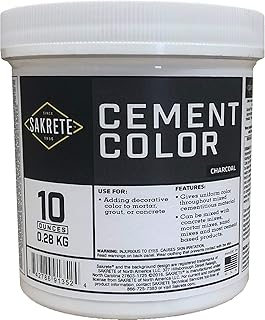
Best for compatibility with established masonry products, offering alkali and UV resistance for durable color on exterior and interior concrete. The charcoal shade provides a classic dark grey that coordinates well with stone, brick, and metal accents.
Who it’s best for: Projects where proven brand reliability and chemical resistance matter. Limitation: Color depth can vary with surface porosity; test on a small area first.
Buying Guide
What to consider when choosing a concrete stain in dark grey:
- Transparency vs. solid color: Semi-transparent stains reveal the concrete texture; opaque options cover more but lose some texture.
- Indoor vs. outdoor use: UV stability and water resistance differ; outdoor projects need UV and weather resistance.
- Application method: Some stains are ready-to-use; others require dilution and layering to achieve depth.
- Area size: Higher-volume containers reduce refills but require more storage and prep work.
- Base color compatibility: Dark greys pair well with natural stone, brick, and metal accents; test shade with your substrate.
- Ventilation and safety: Water-based formulas typically have milder odors; wear PPE as recommended.
Practical tips for best results:
- Prepare the surface by cleaning and repairing any cracks for an even appearance.
- Test color on a small area before full application to confirm shade and opacity.
- Work with wet-on-wet layering if you want marbled or mottled patterns.
- Seal the surface after curing if you require enhanced stain permanence and ease of cleaning.
FAQ
- Q: Can I use these stains on existing sealers or paints?
- A: Most stains require a clean, porous surface for best penetration; remove existing sealers if possible or test in a small area.
- Q: Do these products require a top coat?
- A: Some stains are self-sealing; others may benefit from a compatible sealant for durability.
- Q: How long does a stain take to dry?
- A: Drying times vary by product and climate; follow label instructions for cure times before foot traffic or sealing.
- Q: Can I mix colors to create a custom dark grey?
- A: Yes, several pigments are designed for mixing to achieve specific tones; start with small tests.
- Q: Is staining better than painting concrete?
- A: Stains provide translucency and texture; painting hides texture but can offer stronger color impact.