Whether you’re staining a decorative pathway, adding accents to a patio, or coloring mortar for a cohesive design, choosing the right cement color additive matters. This guide highlights five top pigments that are easy to apply, durable, and suitable for various cement-based projects. Each product is best for different buyers—from DIY homeowners to professional masons—so you can pick the pigment that aligns with your project scope and environment. The quick comparison below helps you spot key differences at a glance.
| Product | Best For | Notes |
|---|---|---|
| Always Bright Concrete Cement Pigment | General color coloring for concrete, mortar, grout, plaster | Iron oxide pigments offer strong coverage and alkali resistance |
| Sakrete Cement Color (Buff) | Outdoor projects needing UV and alkali resistance | Durable color for exposed surfaces |
| OOTDART 5 Colors Matte Iron Oxide Pigment | Architectural and decorative finishes, mixed-media art | Ultra-fine powder with high dispersion and UV resistance |
| Conspec Powdered Color for Concrete | Custom color creation with many options | Pure mineral oxides; highly resistant to fading |
| Quikrete Charcoal Liquid Cement Color | Ready-to-use liquid color for quick projects | Durable, easy to use, USA-made |
Always Bright Concrete Pigment – 200g Pack
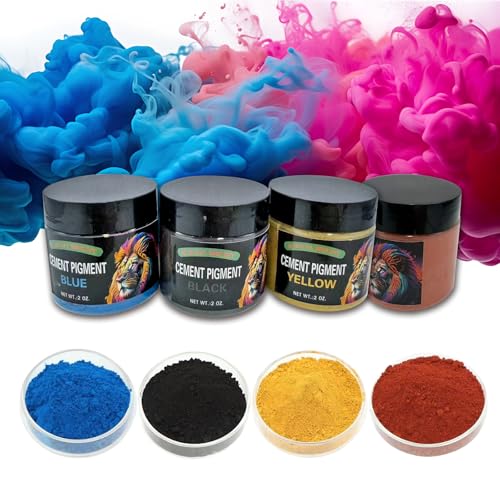
Best for: DIYers coloring cement, mortar, grout, and plaster projects with straightforward application. The product emphasizes easy coloring, strong covering power, and alkali resistance. The packaging includes multiple colors in one set, offering flexible use for different bricks, tiles, or plaster finishes. The main caveat is that powder requires precise mixing ratios to achieve uniform color.
Why selected: It combines practical coverage with alkali and acid resistance, making it suitable for both indoor and outdoor projects where color longevity matters. Use with a 1:25 pigment-to-cement ratio for consistent results.
Caution: Wear gloves and a mask during handling and mixing to avoid inhalation of fine pigments. Mixing requires thorough blending with cement for even color distribution.
Sakrete Cement Color (Buff) – 10 Ounce

Best for: Outdoor surfaces and projects where lasting color with alkali and UV resistance is important. Buff is a versatile neutral tone that blends well with natural stone and wood accents. The product is labeled as alkali and ultraviolet resistant, making it suitable for exterior use.
Why selected: It provides dependable performance with resistance to fading under sun exposure. Choose this if you need a subtler shade that still stands out against concrete textures.
Caution: Like all powder pigments, ensure complete dispersion to avoid streaks. Avoid over-application in a single pour to minimize color variation.
OOTDART 5 Colors Matte Iron Oxide Pigment

Best for: Projects needing precise color customization in decorative concrete, grout, plaster, epoxy coatings, terrazzo, and sculptural work. This pigment is designed for high dispersion and long-lasting indoor/outdoor stability. It’s well-suited for artists and builders aiming for professional finishes.
Why selected: The pigment’s ultra-fine 500 mesh powder enables excellent dispersion, UV resistance, and neutral pH. It supports a wide range of substrates beyond concrete, including resin and lime-based finishes.
Caution: To maximize color depth, mix thoroughly with cement before adding water or mortar. Use protective gear when handling fine powders to minimize inhalation risk.
Conspec 8-oz. Mixed Colors Powdered Color

Best for: Color customization through mixing many colors to achieve bespoke shades for decorative concrete, mortar, grout, and plaster. Ideal for projects that require unique color blends or batch color matching.
Why selected: Conspec offers a broad color range (72 colors) with pure mineral oxides and no fillers, delivering durable color with minimal fading. Mixing allows tailored results for specific design schemes.
Caution: When creating custom blends, document ratios to reproduce colors accurately in future batches. Some combinations may require more pigment to reach desired intensity.
Quikrete Charcoal Liquid Cement Color

Best for: Quick-use projects needing uniform color across cement pours, especially when a dark, charcoal finish is desired. The liquid format simplifies mixing for large slabs or countertops.
Why selected: This product emphasizes ease of use and durability, with a Made in USA assurance. It supports efficient workflows for contractors and DIYers with tight timelines.
Caution: Liquid additives can require careful measurement to avoid color hotspots. Ensure thorough mixing to achieve uniform tone across the entire pour.
Buying Guide: Key Considerations for Cement Color Additives
- Color permanence: Look for alkali and UV resistance to minimize fading in sun-exposed areas.
- Dispersion and particle size: Ultra-fine powders disperse more evenly, reducing streaks.
- Mixing ratio guidance: Some pigments require specific ratios (for example, pigment-to-cement 1:25) to achieve stable color.
- Substrate compatibility: Confirm the pigment works with cement, mortar, grout, plaster, epoxy, or lime-based finishes you plan to color.
- Application method: Powder pigments vs. liquid dyes impact handling, mixing time, and uniformity.
- Safety and handling: Wear gloves and masks when handling fine powders; follow manufacturer instructions for ventilation and disposal.
- Outdoor vs. indoor use: Outdoor projects benefit from UV resistance; indoor projects may require colorfast finishes if exposed to moisture or wear.
- Color matching: For projects requiring consistency across batches, document mixing ratios and test with sample pours before full-scale use.
Frequently Asked Questions
- What is the best pigment for outdoor concrete?
– Choose pigments with alkali and UV resistance to maintain color over time in sun-exposed areas. - How do I mix pigment powder into cement?
– Weigh the pigment, wear protective gear, calculate the pigment-to-cement ratio, then add the powder to dry cement and mix evenly before adding water or mortar. - Can pigments be used with epoxy or plaster finishes?
– Some pigments are formulated for broad compatibility, but verify the product’s intended substrates before use. - Will darker colors hide imperfections better?
– Darker colors can visually mask minor surface flaws, but proper finishing and coating are still crucial for a uniform look. - Are there safety concerns with cement pigments?
– Fine powders can be inhaled; use masks and gloves, work in a well-ventilated area, and follow the product’s safety instructions. - How do I achieve consistent color across batches?
– Use documented mixing ratios, perform a test pour, and maintain the same cement type and batch when possible.