For a 1/4-inch drywall ceiling, fastening into a ceiling joist is generally the safer choice for anything more than a very light decoration. Hollow-wall toggle bolts may suit some projects, but confirm that the anchor can pass through the board and open in the available cavity. The KURUI 164-piece kit is best for varied household jobs, while the 1/4-inch toggle-bolt kits are better for shoppers seeking a specific fastener size. None of the listed products provides a verified load rating specifically for 1/4-inch ceiling drywall.
| Product | Best suited for | Key distinction |
|---|---|---|
| KURUI 164-Piece Assortment | Multiple types of mounting jobs | Self-drilling anchors and three toggle sizes |
| KURUI 28-Piece Toggle Kit | Common hollow-wall projects | Three toggle-bolt sizes |
| 28-Piece Three-Size Toggle Kit | Choosing among three fastener sizes | Zinc-plated carbon steel |
| 15-Piece 1/4-Inch Toggle Kit | Projects specifically calling for 1/4-inch toggles | One listed toggle size |
| Rerdeim 34-Set Kit | Mixed-size toggle-bolt needs | Three sizes and longer screws, per listing |
KURUI 164-Piece Drywall Anchor Assortment

Best for: Homeowners who need several anchor styles for different household tasks. This set combines self-drilling anchors, screws, and metal toggle bolts in multiple sizes, including 1/8-inch, 3/16-inch, and 1/4-inch toggles.
The listing describes self-drilling anchors for installations that do not require pre-drilling and butterfly-style toggles that expand behind hollow drywall. The variety makes this a flexible choice when the mounting hardware or wall conditions vary from project to project.
Why it was selected: It offers more anchor types than the toggle-only kits, making it the broadest option in this group. Limitation: A large assortment does not establish that every included anchor fits 1/4-inch ceiling board. Check each anchor’s instructions and required board thickness before installation.
KURUI 28-Piece Hollow-Wall Toggle Kit
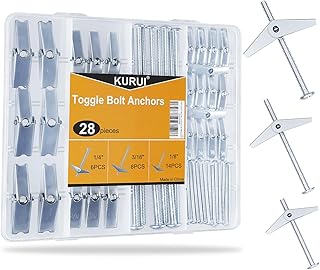
Best for: Buyers looking for a compact assortment of metal toggle bolts in three sizes. The kit includes 1/8-inch, 3/16-inch, and 1/4-inch options, so the fastener can be selected to match the mounting hardware and the installation requirements.
The product listing describes steel toggle bolts and wing nuts with a galvanized coating. Its butterfly wings are designed to open behind a hollow wall, spreading contact over a larger area than a simple fastener against the board surface.
Why it was selected: The three sizes offer more choice than a single-size kit, and the product is explicitly presented for hollow-wall applications. Limitation: The listing cautions that holding performance depends on wall condition, thickness, and correct installation. Confirm that the wings can open fully in the ceiling cavity.
28-Piece Three-Size Toggle Bolt Kit

Best for: Shoppers who want a small metal-anchor kit with three toggle sizes for different hollow-wall mounting needs. It includes 1/8-inch, 3/16-inch, and 1/4-inch toggle bolts and wing nuts.
According to the listing, the hardware is made from zinc-plated carbon steel. The wing nuts spread behind a hollow wall to increase the area against the back of the board. That design may be relevant for ceiling projects, but it does not by itself establish suitability for 1/4-inch drywall.
Why it was selected: It offers three sizes in a straightforward toggle-only assortment, making it easier to compare with the other mixed-size kits. Limitation: The product information does not give a verified load rating for 1/4-inch ceiling drywall. Do not infer a safe ceiling load from the “heavy-duty” wording alone.
15-Piece 1/4-Inch Toggle Bolt Kit

Best for: Buyers whose mounting plan specifically calls for a 1/4-inch toggle bolt. The listing identifies this kit as containing 15 pieces of that size and describes steel construction with a galvanized finish.
The product page mentions applications such as lamps, shelves, curtain hardware, and other installations. These are examples from the listing, not confirmation that any of those items are safe to suspend from 1/4-inch drywall. Ceiling loads and thin board require particular care.
Why it was selected: It is the most direct option in this group for a project specified around 1/4-inch toggles. Limitation: The listing’s stated holding figure is not a verified capacity for a 1/4-inch drywall ceiling. Choose this only after checking the fastener instructions, board thickness, cavity clearance, and actual load path.
Rerdeim 34-Set Mixed Toggle Kit

Best for: Buyers who need several toggle sizes and want the longer screws described in the listing. The 34-piece set includes 1/8-inch, 3/16-inch, and 1/4-inch sizes, with steel construction and a galvanized surface.
The manufacturer lists different holding figures for the three sizes. Those figures should not be treated as safe working loads for a ceiling or as ratings for 1/4-inch drywall. Actual performance depends on the board, installation, spacing, and the item being mounted.
Why it was selected: Its size range and longer-screw detail make it a useful comparison for projects where fastener length matters. Limitation: Verify the screw length and toggle geometry against the ceiling thickness and cavity before buying. The listing’s broad surface claims do not replace checking the specific installation requirements.
Buying Guide: Choosing Anchors for a 1/4-Inch Drywall Ceiling
Drywall is a facing material, not a structural ceiling member. A 1/4-inch board is especially thin, so do not assume that an anchor suitable for ordinary wall drywall will be appropriate overhead. A ceiling-mounted object can fall if the board tears, the fastener is installed incorrectly, or the anchor does not have enough room to deploy.
Can you fasten into a joist instead?
For heavier or safety-sensitive items, locate a ceiling joist and fasten into that framing with hardware appropriate for the item and installation. A joist provides a structural attachment point; the drywall alone does not. If the joist location is uncertain, use a suitable locating method or ask a qualified installer to assess the ceiling.
For objects that could injure someone if they fall, do not rely on an unverified drywall-anchor load claim. Follow the fixture manufacturer’s mounting instructions and confirm the structure can support the installation.
Will a toggle bolt work with 1/4-inch drywall?
Not automatically. Toggle bolts are designed to open behind a hollow wall, but the anchor must fit through the hole and have enough free space behind the board to open completely. The fastener must also be suitable for the board thickness. Check the specific product instructions for minimum and maximum material thickness, hole size, screw length, and required cavity clearance.
A ceiling cavity may contain framing, wiring, plumbing, insulation, or other obstructions. Do not drill until the location has been checked for hidden services and the toggle’s wings have a clear deployment path.
How should you choose between these kits?
- Choose a mixed assortment when you need different anchor types for several projects. The KURUI 164-piece kit includes self-drilling anchors as well as toggles.
- Choose a three-size toggle kit when you need to compare 1/8-inch, 3/16-inch, and 1/4-inch toggle options for a compatible hollow-wall installation.
- Choose the 1/4-inch-only kit when the mounting hardware specifically calls for that toggle size and the product instructions match the ceiling construction.
- Choose joist fastening when the mounted object is heavy, valuable, or potentially hazardous if it falls.
Do not select an anchor solely because its name includes “heavy duty” or “ceiling.” A product’s suitability depends on the actual substrate, fastener dimensions, installation method, and load direction. A wall-use example does not prove suitability overhead.
What should you check before installation?
- Measure or confirm the drywall thickness rather than assuming it is standard.
- Read the anchor’s instructions for board thickness, drill-hole diameter, screw length, and installation steps.
- Confirm that the toggle wings can pass through the opening and open fully behind the board.
- Check for joists and hidden wiring, plumbing, or other obstructions before drilling.
- Use the correct number and spacing of fasteners only when the product and mounted item instructions specify them.
- Stop if the board is cracked, soft, damp, damaged, or separating from the framing.
Frequently Asked Questions
Is 1/4-inch drywall strong enough to hold a ceiling fixture?
Drywall thickness alone does not establish that a ceiling fixture can be safely supported. For a fixture with meaningful weight or potential to cause injury, fasten to structural framing or follow the fixture manufacturer’s specified support method.
Are toggle bolts better than plastic anchors for ceilings?
Toggle bolts spread their wings behind a hollow wall, while plastic anchors use a different holding mechanism. Neither type is automatically suitable for every ceiling. Match the anchor to the exact board thickness, cavity, load, and manufacturer instructions.
Can I use a 1/4-inch toggle bolt in 1/4-inch drywall?
The toggle’s nominal size does not confirm compatibility with 1/4-inch board. Check the product instructions for the supported material thickness, hole size, screw length, and required cavity clearance before installation.
Do the listed load claims apply to ceiling installations?
No. Product listing figures are not verified here as safe working loads for 1/4-inch ceiling drywall. Ceiling orientation, board condition, installation quality, and the mounting item all affect performance.
What is the safest way to hang a heavy item overhead?
Attach the item to a ceiling joist or another structural support using hardware specified for the installation. If the support location or load requirements are unclear, consult a qualified professional rather than relying on a drywall anchor alone.


