The best 1000 grit polishing compound depends on the material you are finishing: diamond paste is the clearest match for measured 1,000-grit work on glass, metal, stone, and similar surfaces, while the other picks are automotive compounds whose listings do not specify a 1,000-grit rating. The products below include options for precision lapping, car paint correction, and staged polishing. Check the product’s stated use and abrasive scale before choosing; “1000” in a product name does not always mean 1,000 grit.
| Product | Best suited for | What the listing specifies |
|---|---|---|
| Diamond Paste, 1,000 Grit | Glass, jewelry, stone, and precision work | 1,000 grit; 15–17 microns |
| Menzerna Heavy Cut Compound 1000 | Automotive paint correction | Heavy-cut compound; no grit rating provided |
| Menzerna Polishing Set | Multi-step paint correction | Three compounds: HCC1000, MCC2500, and 3800 |
| RUPES D-A Fine | Fine automotive paint defects | Fine polishing compound; no grit rating provided |
| SONAX CutMax | Automotive cutting and correction | Cutting compound; no grit rating provided |
Diamond Paste, 1,000 Grit

Best for: Buyers who need an explicitly labeled 1,000-grit compound for fine lapping, pre-polishing, or light scratch removal on suitable hard surfaces. This is the most direct match in this selection because the listing states both 1,000 grit and a 15–17-micron particle size.
The oil-based paste contains 30% diamond powder and comes in a 40-gram package. Listed applications include glass, watch crystals, mirrors, metal, jewelry, marble, rock, resin, epoxy repair, and blade sharpening. The listing describes hand and machine use, with wool polishing wheels or leather strops as suggested pairings.
Why it was selected: Its stated grit and broad material applications make it more relevant to a general search for 1000 grit polishing compound than products named for automotive cutting steps.
Limitation: It is an oil-based diamond paste, not a universal automotive paint compound. Confirm that the workpiece and polishing method are appropriate for diamond abrasive before use.
Menzerna Heavy Cut Compound 1000

Best for: Automotive detailing buyers seeking a heavy-cut compound for paint defects rather than a measured 1,000-grit abrasive. The product name includes “1000,” and the listing identifies it for deep scratches, sanding marks, swirls, and holograms.
The 8-fluid-ounce compound is described as silicone-free and intended for buffing and polishing. It is a better fit for someone comparing automotive correction compounds than for a buyer who needs a known particle size for glass, stone, or metal lapping.
Why it was selected: It is relevant to people who use “1000 grit polishing compound” while searching for a correction compound for a vehicle. The listing’s stated defect targets provide a clear automotive use case.
Limitation: The available product information does not give a grit equivalent, abrasive particle size, or detailed application instructions. Do not treat the “1000” in its name as proof that it matches 1,000-grit sandpaper or diamond paste.
Menzerna Three-Step Polishing Set
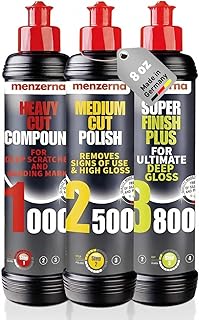
Best for: Automotive users who want a staged correction set instead of selecting one compound. The listed three-step system includes HCC1000, MCC2500, and 3800, and is presented for scratch removal, swirl elimination, and a mirror-like finish.
The set offers more than one correction stage, which can be useful when a single heavy-cut product is not the only step in the finishing plan. Its “1000” component connects it to the search topic, but the listing does not state that the number is a grit measurement.
Why it was selected: It gives paint-correction buyers a bundled sequence to compare against buying a standalone heavy-cut or fine compound. It is better for users seeking multiple polishing stages than for a person who needs one specified abrasive size.
Limitation: The provided details do not identify the exact abrasive scale for each compound or explain pad selection and sequence. Review the product instructions before use, particularly if the task requires a specific grit rating.
RUPES D-A Fine Compound

Best for: Car owners and detailers looking for a fine automotive compound aimed at removing fine defects and swirl marks. The listing describes micro-abrasive technology and identifies the product as a high-performance polishing compound for car detailing.
The package is listed as 1,000 milliliters. It is a better fit for paint refinement than for measured 1,000-grit lapping on glass, jewelry, or metal. The “Fine” name and stated defect-removal purpose distinguish it from the heavy-cut option in this group.
Why it was selected: It provides a comparison point for buyers who want a finer automotive polishing step rather than a compound marketed for deep scratches or sanding marks.
Limitation: The product information provided does not specify a grit rating, compatible pad, or detailed process. Choose it based on its stated fine-defect and swirl-removal purpose, not as a verified 1,000-grit substitute.
SONAX CutMax Cutting Compound

Best for: Automotive users comparing cutting compounds for paint correction. The product name identifies it as a cutting compound, and the listing gives a 1,000-milliliter package size.
Compared with the RUPES fine compound, SONAX CutMax is positioned by its name as a cutting product rather than a fine finishing compound. That distinction can help buyers narrow their search when deciding whether the task calls for a cutting-stage product or a refinement-stage product.
Why it was selected: It is a relevant automotive alternative for searchers whose intended use is vehicle correction, even though the available information does not confirm a 1,000-grit equivalence.
Limitation: The supplied listing details do not describe its defect range, abrasive size, application method, or finishing step. Do not assume it has a specific grit rating based on the search keyword alone.
Buying Guide: How to Choose a 1000 Grit Polishing Compound
Does “1000” mean the same thing on every compound?
No. A grit number, a compound’s product name, and an automotive cut category are not interchangeable measurements. In this selection, the diamond paste explicitly states 1,000 grit and a 15–17-micron particle size. The Menzerna product names include “1000,” but the available product details do not establish a grit equivalence. RUPES D-A Fine and SONAX CutMax are described by their polishing or cutting roles, not by a 1,000-grit specification.
When the task requires a particular abrasive size, look for a stated grit rating or particle size in the product information. If the listing does not provide one, ask the manufacturer or consult the technical documentation rather than estimating from the name.
What material are you polishing?
Start with the workpiece. Diamond paste is listed for hard materials such as glass, watch crystals, mirrors, metals, jewelry, marble, rock, and resin. Automotive compounds are presented for car detailing and paint correction. A compound made for one surface should not automatically be used on another; the abrasive, carrier, and application method may not suit the material.
For delicate or valuable pieces, test the method on an inconspicuous area when practical and follow the product’s directions. Surface coatings, edges, and thin components may react differently from a solid piece of the same material.
Do you need cutting, correction, or final refinement?
A cutting compound is generally selected for correction work, while a fine polishing compound is aimed at refinement. The provided listings describe Menzerna Heavy Cut Compound 1000 as targeting deep scratches, sanding marks, swirls, and holograms. RUPES D-A Fine is described for fine defects and swirl marks. The Menzerna set supplies three named stages, so it may suit buyers who want a multi-step option.
These descriptions help compare intended roles, but they do not establish an exact grit conversion. Choose according to the surface defect and the product’s stated use rather than assuming that two products with similar numbers will cut identically.
Should you choose paste, a single compound, or a set?
A paste can suit precision tasks where the listed grit and material compatibility matter. A single automotive compound is a more focused choice when the job matches its stated correction role. A set may be preferable if you want products labeled for multiple stages, but it requires understanding the intended order and process.
Package quantity alone does not show how much product a job requires. Compare the listed size and application area, then follow the product directions for how much to apply and which tools to use.
How should you compare application methods?
The diamond paste listing identifies both hand and machine polishing and suggests wool polishing wheels or leather strops. The supplied descriptions for the automotive products do not provide complete tool or pad guidance. Check each product’s instructions for equipment, surface preparation, and removal of residue. Avoid mixing compounds on the same pad or work area unless the manufacturer’s instructions allow it, since leftover abrasive can affect the finish.
What should you check before buying?
- Exact abrasive information: Confirm grit or micron size if a measured abrasive is essential.
- Material match: Use a compound listed for the surface you are polishing.
- Correction stage: Distinguish heavy cutting from fine polishing and multi-step systems.
- Package amount: Compare the stated weight or volume with the scale of the project.
- Instructions: Verify the recommended method, tools, and precautions from the product documentation.
Frequently Asked Questions
What is 1000 grit polishing compound used for?
It is used for abrasive polishing or pre-polishing when the product is specifically rated at 1,000 grit. The suitable material and result depend on the compound’s formulation. The diamond paste listed here names glass, metal, jewelry, stone, and other applications.
Is Menzerna Heavy Cut Compound 1000 the same as 1,000-grit compound?
The available product information does not confirm that. It describes a heavy-cut automotive compound and names the product “1000,” but does not provide a grit or particle-size rating. Treat the number as part of the product name unless documentation says otherwise.
Can diamond paste be used on a car’s paint?
The supplied listing does not identify automotive paint as an application. It names glass, metal, jewelry, stone, resin, epoxy, and related work. Choose a product specifically intended for automotive paint instead of assuming the paste is suitable.
Which option is best for fine defects on automotive paint?
RUPES D-A Fine is the option in this selection explicitly described for fine defects and swirl marks. Its listing does not specify a grit rating, so it is not a verified substitute for measured 1,000-grit compound.
Is a polishing set better than one compound?
A set may be more suitable when the job calls for several correction stages. The Menzerna set includes HCC1000, MCC2500, and 3800. A single compound is simpler to compare when the task matches one stated purpose, but follow the manufacturer’s directions for the chosen product.


