For repairing exposed plywood and furniture edges, pre-glued iron-on wood veneer banding is a practical choice. The five options below are 3/4-inch rolls; most are birch, while one is pine. Edge Supply is best for buyers who want flexible birch veneer and several application methods, BEVTEE for a paintable birch surface, and Skelang for a pine trim option. Compare wood species, roll length, thickness, and application details before choosing.
| Product | Material | Width and Length | Best For |
|---|---|---|---|
| BEVTEE Birch Edge Banding | Birch veneer | 3/4 inch × 50 feet | Paintable furniture repairs |
| Edge Supply Birch Edge Banding | A-grade birch veneer | 3/4 inch × 50 feet | Flexible, multi-method application |
| GSCIT Club Birch Edge Banding | Real birch veneer | 3/4 inch × 50 feet | Everyday cabinet repairs |
| Skelang Pine Edge Banding | Pine veneer | 3/4 inch × 50 feet | Projects calling for pine trim |
| Birch Edge Banding, 0.8 mm | Birch veneer | 3/4 inch × 50 feet | Buyers seeking a thicker listed option |
BEVTEE Paintable Birch Edge Banding

BEVTEE is a pre-glued birch veneer roll intended for finishing or restoring cabinetry, furniture, shelving, and crafts. The roll measures 3/4 inch wide by 50 feet long and is listed at 0.6 mm thick. Its real-wood veneer surface is described as smooth, and the product is identified as paintable.
The hot-melt adhesive is already applied to the back. The stated installation method is to position the banding and activate the adhesive with an iron. The flexible strip is designed to bend around project edges, while its birch surface provides a natural wood appearance.
- Best for: DIYers who want a paintable birch veneer strip for cabinetry or furniture repair.
- Why it stands out: It combines a 50-foot roll, pre-applied adhesive, and a paintable surface.
- Limitation: The listed width is 3/4 inch, so measure the edge to be covered before ordering.
Choose this if paintability is important and the project calls for birch. The product information does not specify a particular paint or finishing system, so confirm that your intended finish is suitable for the surface.
Edge Supply Flexible Birch Veneer Tape

Edge Supply’s roll is made from real birch veneer described as extra-clean A-grade wood. It measures 3/4 inch by 50 feet and has a finely sanded surface. The pre-applied hot-melt adhesive is described as German-engineered, and the product listing gives several ways to activate it: a household iron, heat blower, or edge-banding machine.
The listing says the flexible banding can bend around flat and curved surfaces and can be cut with scissors. This makes it a versatile choice for projects that include shaped edges or for users who have more than one suitable heat-application tool.
- Best for: Woodworkers and DIYers who want flexible birch banding with multiple listed application methods.
- Why it stands out: Its stated tool options and flexibility offer more application choices than a listing that mentions only an iron.
- Limitation: The product is birch veneer, so choose another option if the project specifically requires pine or a different wood species.
Choose this if you value flexibility in both the workpiece shape and the method used to activate the adhesive. Follow the product instructions and test your process on a small offcut when possible.
GSCIT Club Birch Banding for Cabinet Repair

GSCIT Club offers a 3/4-inch-wide, 50-foot roll of real birch veneer edge banding. Its listed thickness is 0.6 mm. The back has pre-applied heat-melt adhesive, and the product instructions describe holding the banding in place, passing a heated iron over it, allowing it to cool, and trimming the sides with a utility knife.
The listing describes the surface as smooth and the veneer as durable and elastic. It presents the material as an option for laminate and cabinet repairs, as well as furniture restoration. Because the roll is a standard 3/4-inch width, it is suited to edges that match that coverage requirement.
- Best for: Homeowners repairing cabinet or furniture edges with a basic iron-on process.
- Why it stands out: The listing clearly identifies the roll dimensions, thickness, pre-applied adhesive, and a simple installation sequence.
- Limitation: The stated 0.6 mm thickness may not match a project requiring a thicker band.
Choose this if a straightforward birch repair roll fits your project. The instructions call for trimming after the adhesive cools; use care with a utility knife and avoid cutting into the finished panel face.
Skelang Pine Iron-On Edge Banding

Skelang’s product is identified as pine edge banding in a 3/4-inch by 50-foot roll. The title describes it as pre-glued and intended for iron-on use on cabinets, tables, and doors. Unlike the other listed products, this option is pine rather than birch, which can matter when the visible trim should coordinate with a pine project.
The available product details do not state a thickness, provide a full installation procedure, or describe the adhesive beyond calling the strip pre-glued. Review the listing for current application instructions and confirm that the wood species and dimensions suit the surface before starting work.
- Best for: Buyers looking specifically for pine trim in a 3/4-inch-wide, 50-foot roll.
- Why it stands out: It offers a listed pine alternative to the birch veneer options.
- Limitation: The supplied product information gives fewer adhesive and installation details than the other options.
Choose this if matching a pine project is more important than having detailed specifications in the product description. Avoid choosing by species name alone if color or grain matching is critical; compare the banding with the workpiece before applying it.
Thicker Birch Banding for Edge Repairs
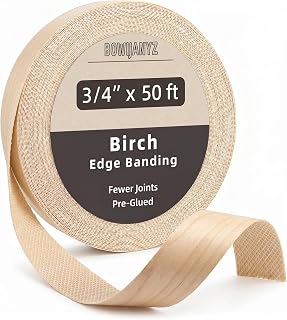
This birch veneer edge banding comes in a 3/4-inch-wide, 50-foot roll and is listed at 0.8 mm thick. Its hot-melt adhesive is pre-applied. The product details describe a smooth surface, natural grain, and flexible veneer for cabinets, furniture, shelves, and DIY crafts.
The listed application methods include a household iron or heat gun. After heating the adhesive, the instructions say to let the banding cool and trim the edges with a craft knife. The listing also notes that the surface can be lightly sanded before staining or painting if needed.
- Best for: Buyers who want birch veneer and prefer the listed 0.8 mm thickness over 0.6 mm options.
- Why it stands out: It explicitly states the thickness and describes heat application, trimming, and optional light sanding.
- Limitation: It is still only 3/4 inch wide, so it will not cover a wider edge without a different-sized product.
Choose this if its listed thickness and finishing guidance suit the job. The product description does not establish that it is universally more durable than thinner banding, so select based on the actual edge dimensions and finish requirements.
Buying Guide: How to Choose Iron-On Wood Trim
What width should you buy?
Measure the panel edge you need to cover before selecting a roll. All five options listed here are 3/4 inch wide. That dimension may suit many cabinet and furniture edges, but it should not be assumed to fit every panel. If your measured edge is wider, look for banding with a matching width rather than relying on a narrow strip to cover it.
Allow enough material for the full edge and any cuts or mistakes. The listed rolls are 50 feet long, but the usable amount depends on the number and length of the edges and how much is trimmed during installation.
Should you choose birch or pine?
Choose the wood species with the finished project in mind. Birch banding is the majority option in this selection and is offered by BEVTEE, Edge Supply, GSCIT Club, and the 0.8 mm product. Skelang is listed as pine. Wood species alone does not guarantee an exact match in color or grain, so compare the trim with the panel and consider the finish you plan to apply.
For a repair where the edge will remain visible, matching the existing material and finish can affect the appearance. If you intend to paint the edge, BEVTEE specifically describes its surface as paintable. The other listings provide different finishing details, so check their instructions before applying paint or stain.
How important is banding thickness?
Thickness can affect how the trim meets the panel edge and how much material is available for trimming or sanding. BEVTEE and GSCIT Club list 0.6 mm thickness; the fifth birch option lists 0.8 mm. The Edge Supply and Skelang details provided here do not specify thickness. Compare the stated measurement with your project needs, and do not assume an unspecified thickness is identical to another product’s.
What tools can activate the adhesive?
Each product has pre-applied adhesive or is described as pre-glued, but the stated application options vary. BEVTEE and GSCIT Club describe iron-on use. Edge Supply lists a household iron, heat blower, or edge-banding machine. The 0.8 mm birch listing mentions an iron or heat gun. Skelang’s supplied details identify it as iron-on but do not give a more complete process.
Use the instructions provided for the product you select. The general process described by several listings is to position the strip, apply heat to activate the hot-melt adhesive, allow it to cool, and then trim the excess. Follow the product-specific guidance rather than assuming every adhesive responds identically.
How should you plan trimming and finishing?
Trim excess material only after the adhesive has cooled when that is what the product instructions specify. GSCIT Club mentions using a utility knife, while the 0.8 mm birch option mentions a craft knife. Edge Supply says its banding can be cut with scissors. Select a cutting method that suits the material and work carefully to avoid damaging the veneer or panel face.
Finishing directions differ. The 0.8 mm birch listing says the surface can be lightly sanded before staining or painting, and BEVTEE identifies its veneer as paintable. If the edge will receive a finish, check the selected product’s instructions and test the intended approach on a spare piece when available.
Which option is best for a curved edge?
Edge Supply specifically describes its birch strip as flexible and suitable for bending around flat and curved surfaces. BEVTEE also describes its banding as bendable. For a curved edge, prioritize a product whose details explicitly mention flexibility, and assess the curve and material before committing the full length.
How much should you buy?
Estimate the total length of all edges to be covered, then allow extra for trimming and project errors. Each option in this selection is listed as a 50-foot roll. A single roll may be excessive for a small repair or insufficient for a larger installation, depending on the measured total. Planning the cuts in advance can help reduce waste and avoid running short mid-project.
Frequently Asked Questions
What is iron-on wood trim?
Iron-on wood trim, often called wood veneer edge banding, is a narrow strip of veneer with heat-melt adhesive pre-applied to its back. Heat activates the adhesive so the strip can attach to an exposed panel edge.
Can I apply pre-glued edge banding with a household iron?
Several products in this selection specify a household iron as an application method. Edge Supply also lists a heat blower or edge-banding machine, and the 0.8 mm birch option lists an iron or heat gun. Follow the instructions for the specific roll you buy.
Is birch edge banding paintable?
BEVTEE specifically describes its birch veneer as paintable. Another birch listing mentions light sanding before staining or painting. Check each product’s finishing directions because the supplied details do not establish the same finish compatibility for every roll.
What is the difference between 0.6 mm and 0.8 mm banding?
The listed 0.8 mm banding is thicker by 0.2 mm than the options listed at 0.6 mm. Compare that measurement with the panel edge and trimming requirements. The product details do not prove that one thickness is better for every repair.
Can iron-on wood banding be used on curved edges?
Edge Supply describes its birch banding as flexible enough for curved surfaces, and BEVTEE describes its strip as bendable. Check the product details and assess the curve before applying the full strip.
How do I choose between birch and pine edge banding?
Choose birch when birch veneer best suits the project, or pine when you specifically want a pine option. The products listed here include four birch choices and one pine choice. Compare the visible grain and finish with the panel because species names alone do not guarantee an exact match.


