The best 4×8 stone veneer panels depend on whether you need flexible coverage, dimensional faux stone, or an interlocking system. From Plain To Beautiful In Hours is the closest match to a full 4-by-8 format and suits buyers covering a large area or wrapping curves. For rigid 3D texture, iPormis and Tepvyr offer lightweight polyurethane panels. LarWorks is a better fit for bending around columns and corners, while Ekena Millwork offers a tongue-and-groove design for a more continuous-looking installation.
| Panel | Best For | Format or Coverage |
|---|---|---|
| From Plain To Beautiful In Hours | Large areas and curved surfaces | Two 4-by-8-foot panels; 64 sq. ft. stated |
| iPormis | Charcoal-gray 3D texture | Six panels, each 44.9 by 11.9 inches |
| LarWorks | Flexible gray stone finish | Four panels; 31.2 sq. ft. stated |
| Tepvyr | Lightweight faux-stone siding | Four panels, each 45.7 by 11.8 inches |
| Ekena Millwork | Interlocking stacked-stone look | One panel, 48 5/8 by 24 3/4 inches |
From Plain To Beautiful Flexible Clay Stone

Best for: Buyers who want panels in a 4-by-8-foot format, need broad stated coverage, or are dressing curved surfaces. The listing describes a pack of two panels covering 64 square feet, making it the clearest match among these options for shoppers specifically searching for 4×8 stone veneer panels.
The flexible backing is designed to bend around circular columns, arches, curved walls, and uneven surfaces. The product is described as having a real-stone appearance and suitability for interior and exterior use, including humid or wet areas such as bathrooms, showers, and kitchens. Its stated lightweight construction may also appeal to buyers who want a stone-like finish without handling conventional heavy stone.
Why it was selected: It combines the requested 4-by-8 format with flexibility and stated indoor-outdoor use. Limitation: Confirm the installation requirements and suitability for your specific wet-area or exterior application before purchase; the product details do not specify installation method or substrate requirements.
iPormis Charcoal Gray Faux Stone Panels
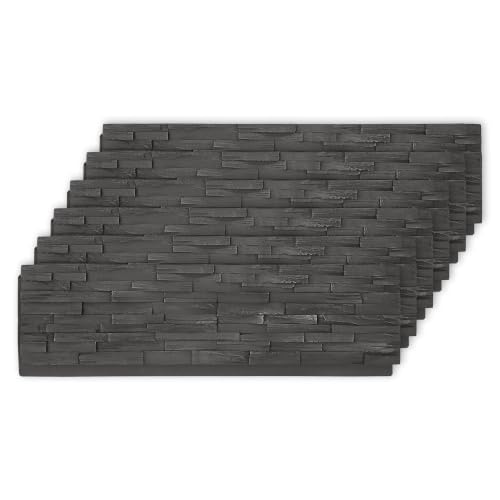
Best for: Shoppers who prefer a dark, strongly textured faux-stone finish for an accent wall, porch, garage, or other decorative project. This six-panel set uses polyurethane and has individual panels measuring 44.9 inches long by 11.9 inches high by 1.5 inches deep. It is not a single 4-by-8 sheet, so calculate the layout and panel count using the listed dimensions rather than assuming full-sheet coverage.
The panels have deep 3D texture and layered stone details. The listing describes them as lightweight and designed for indoor and outdoor wall décor, with waterproof, moisture-resistant, corrosion-resistant, UV-resistant, and flame-retardant surface properties. Suggested uses include accent walls, fireplace surrounds, kitchens, bathrooms, patios, and porches.
Why it was selected: It is a relevant alternative for buyers comparing stone-look panels by color, depth, and stated environmental resistance. Limitation: The pronounced 1.5-inch depth may affect how the finished wall meets trim, outlets, or adjoining surfaces. Check clearances before planning the layout.
LarWorks Flexible Soft Stone Panels
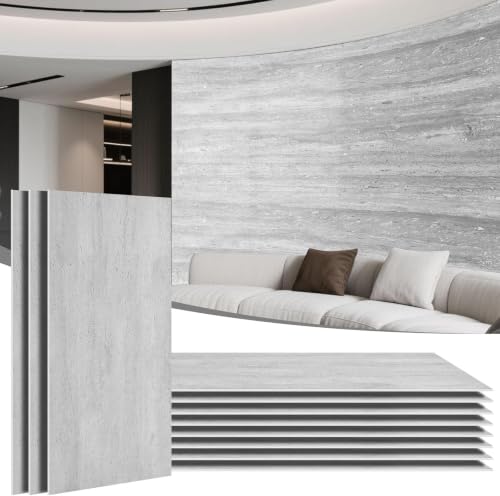
Best for: Buyers who need a flexible panel for rounded corners, columns, arches, or other irregular surfaces. The four-pack is listed as covering 31.2 square feet, with each panel measuring 47.6 by 23.6 inches. That size is close to 4 by 2 feet, not 4 by 8 feet, so it may suit projects where smaller, bendable panels are easier to position.
LarWorks describes the panels as flexible and bendable, with a textured gray finish and interlocking design. The product is listed for interior and exterior walls and described as waterproof and made for outdoor conditions. The listing also states that the material will not fade, though buyers should confirm project-specific installation and maintenance instructions.
Why it was selected: Flexibility is the main differentiator for projects where rigid panels could be difficult to fit. The listed pack coverage also makes it possible to estimate how many sets a wall may require. Limitation: This is not a full 4-by-8 panel format, and the stated pack coverage is substantially less than the first product’s listed coverage.
Tepvyr Four-Pack Faux Stone Siding

Best for: Buyers seeking a lightweight, stone-effect wall covering in relatively narrow panels. Each of the four panels measures 45.7 inches long by 11.8 inches high by 1.18 inches deep. This format can be useful for working in sections, but it is different from a 4-by-8 sheet and should be planned as a panel-by-panel installation.
The polyurethane panels feature deep 3D texture and layered detailing intended to create a rock-wall appearance. The listing describes them as lightweight and suitable for indoor and outdoor decorative uses, including accent walls, kitchens, bathrooms, patios, porches, and garages. It also lists waterproof, moisture-resistant, corrosion-resistant, UV-resistant, and flame-retardant surface properties.
Why it was selected: It gives buyers another compact-format PU option to compare with iPormis, particularly when panel dimensions and a lighter stone-effect finish matter. Limitation: No total square-foot coverage is provided in the supplied product details, so verify the package coverage and calculate the required quantity before ordering.
Ekena Millwork Cascade Stacked Stone Panel

Best for: Buyers who want a defined stacked-stone look and value interlocking panel edges. This polyurethane panel measures 48 5/8 inches wide by 24 3/4 inches high by 1 1/4 inches deep. It is not a 4-by-8 panel, but its width is close to four feet and its tongue-and-groove design is intended to make adjoining panels form a more continuous finish.
The product description highlights lightweight construction for DIY handling and a molded stone appearance. It is described as UV-resistant and water-resistant for interior accents and exterior wall cladding. Its interlocking design is intended to help conceal joints between panels, which can matter when creating a larger accent wall or foundation wrap.
Why it was selected: It offers a useful comparison for shoppers choosing between flexible sheet-like panels and rigid, interlocking faux-stone panels. Limitation: The single-panel dimensions provide less coverage than a full 4-by-8 sheet, so larger projects may require more panels and careful seam planning.
Buying Guide: How to Choose 4×8 Stone Veneer Panels
Do you need an actual 4-by-8 panel?
Check the listed dimensions rather than relying on a product title that uses “stone veneer” or “wall panel.” A 4-by-8 panel measures 48 by 96 inches. In this selection, From Plain To Beautiful In Hours is explicitly listed as a 4-by-8-foot panel, while the other products are smaller individual panels. Smaller panels can still cover a large wall, but they create more joints and require a different quantity calculation.
Also distinguish individual panel dimensions from package coverage. A pack may contain several panels, and the package’s total stated square footage is the most direct starting point for estimating quantity. Confirm that the coverage figure reflects usable installed area, especially if panels overlap or interlock.
How much coverage should you calculate?
Measure the height and width of each wall section, then multiply those measurements to find its area in square feet. Add the areas together for multiple surfaces. Compare that total with the product’s stated package coverage, not just the dimensions of one panel. For example, the LarWorks listing states 31.2 square feet per four-pack, while the first product lists 64 square feet for two 4-by-8 panels.
Allow for cuts, corners, openings, and layout choices when determining how many packs to buy. Do not assume every listed package has the same coverage or that a panel’s overall dimensions equal its usable installed area. Check the current package details and installation instructions before ordering.
Should you choose flexible panels or rigid PU panels?
Flexible stone panels are generally the more relevant option when a wall includes rounded columns, arches, or uneven surfaces. From Plain To Beautiful In Hours and LarWorks both describe flexible construction. Confirm the product’s permitted bend radius and cutting or fastening instructions if the surface has a tight curve; the supplied descriptions do not provide those specifications.
Rigid polyurethane panels are a better match when the goal is a deep, molded 3D surface and the wall is relatively flat. iPormis, Tepvyr, and Ekena Millwork list polyurethane construction. Their panel depth and edge design can influence trim, corners, outlets, and how the joints look, so review those details alongside the surface texture.
What should you check for indoor or outdoor use?
Match the product’s stated use to the location. The listed options describe various degrees of water resistance, moisture resistance, UV resistance, or suitability for exterior applications. These claims do not replace installation instructions or local building requirements. For a bathroom, shower, kitchen, porch, or exterior wall, confirm whether the specific panel is appropriate for that exposure and what substrate, sealant, or edge treatment is required.
For fireplaces and other heat-exposed areas, do not assume that a product described as flame-retardant is suitable for direct contact with heat. Follow the product’s stated clearances and applicable safety guidance. The supplied descriptions do not specify complete installation requirements for every use case.
How important are panel joints and appearance?
Panel size affects the number of seams, while edge design affects how those seams can be finished. Ekena Millwork describes a tongue-and-groove system intended to interlock and help conceal joints. LarWorks also describes an interlocking design. Flexible panels may be more adaptable around curves, while smaller rigid panels may require extra attention to alignment and transitions.
Compare color, texture depth, stone pattern, and panel orientation with the rest of the room or exterior. A dark charcoal finish can create a different visual effect from gray or sand-colored stone. If the project spans a large area, check whether multiple packs maintain a consistent pattern and whether the manufacturer provides guidance for staggering seams.
What installation details should you verify?
Before buying, identify the required tools, attachment method, substrate preparation, cutting approach, and corner or edge treatment. The product descriptions vary in how much installation detail they provide. Lightweight construction may make panels easier to handle than conventional stone, but it does not establish that a panel can be installed on every surface or without specific preparation.
Review the package dimensions and installation instructions for the exact product. Plan around windows, doors, outlets, trim, and transitions to other wall materials. If the installation is in a wet or exterior area, confirm how joints and cut edges should be handled for that setting.
Frequently Asked Questions
Are all stone veneer panels listed here 4 by 8 feet?
No. From Plain To Beautiful In Hours is listed as a 4-by-8-foot panel sold in a two-pack. The other selections are smaller panels, so check their individual dimensions and package coverage before comparing quantities.
Which option is best for a curved wall or column?
From Plain To Beautiful In Hours and LarWorks are described as flexible and bendable. They are the most directly relevant choices here for columns, arches, rounded corners, and other irregular surfaces. Confirm the permitted bend and installation method for the specific project.
Which panels have a 3D faux-stone texture?
iPormis and Tepvyr describe deep 3D textures and layered stone details. Ekena Millwork describes a molded stacked-stone appearance. These are rigid polyurethane options rather than full 4-by-8 sheets.
Can these panels be used outdoors?
Several listings describe their panels as suitable for exterior use and mention properties such as water resistance, waterproofing, or UV resistance. Check each product’s installation requirements and suitability for the exact climate and exposure before using it outdoors.
How do I estimate how many panels to buy?
Measure the project area, calculate its square footage, and divide by the product’s stated coverage per package. Adjust for cuts, openings, and layout. When package coverage is not stated, use the panel dimensions to estimate coverage and verify the usable area with the seller’s current product information.


