Small paint brushes for trim help control paint along baseboards, window sashes, corners, and other narrow edges. The GACDR six-brush set is best for buyers who want several small sizes, while the Bates 0.45-inch two-pack suits very fine detail work. For broader projects that also need larger brushes, the Pro Grade five-piece set offers more size variety. Compare the brush widths and intended tasks below before choosing.
| Product | Best For | Brush Sizes |
|---|---|---|
| GACDR Slant Lining Fitch Set | Small trim and varied detail work | 0.5, 0.75, and 1 inch |
| Bates Three-Piece Trim Set | Common trim widths and comfortable handling | 5/8, 3/4, and 1 inch |
| Pro Grade Five-Piece Set | Trim plus larger painting tasks | 1 to 2.5 inches |
| Wesquer Three-Pack | Narrow edges, touch-ups, and crafts | 0.6, 0.7, and 0.8 inch |
| Bates 0.45-Inch Two-Pack | Fine trim details and tight spaces | 0.45 inch |
GACDR Slant Lining Fitch Trim Brush Set

Best for: DIY painters who want several narrow brush widths for edging, corners, and touch-ups. This six-piece set includes two brushes each in 0.5-, 0.75-, and 1-inch sizes, so users can keep a preferred width available or switch brushes for different sections of a project.
The product features describe firm, high-density synthetic bristles with micro-tipped ends. The angled profile is intended to support controlled cutting-in, and the brush heads are described as designed to resist splaying and distribute paint evenly. The listed uses include trim, ceilings, corners, hobbies, and crafts.
Why it was selected: Its three small widths cover a useful range for narrow trim and detail tasks, and the two-of-each format offers a spare in every size. Choose this set if brush width flexibility matters more than having a broad wall brush.
Limitation: The largest brush is 1 inch wide, so this set is less suited to covering broad flat areas quickly.
Bates Three-Piece Trim Brush Set
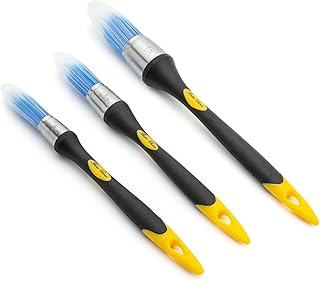
Best for: Painters looking for a simple set of common small brush widths for trim, corners, and detail painting. The set contains 5/8-, 3/4-, and 1-inch brushes, giving buyers options for different edge widths without adding larger brushes intended for broad surfaces.
Bates describes the brushes as having finely bristled ends for smooth application and ergonomic handles for a comfortable grip during longer painting sessions. The stated uses include edges, corners, trim work, and detail painting. Those features make this set a practical choice when handling comfort and a small size range are priorities.
Why it was selected: The stepped widths make it easier to choose a smaller brush for a tight line or a wider one for a more open section of trim. It is better suited to routine household detail work than a set with only one very narrow brush.
Limitation: The listed features do not specify bristle material or paint-type compatibility, so check the product details for your intended coating before buying.
Pro Grade Five-Piece Paint Brush Set
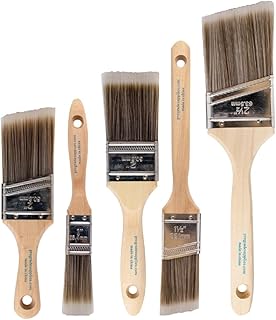
Best for: Buyers who need small trim brushes as well as wider brushes for doors, cabinets, furniture, or other surfaces. The set includes a 1-inch flat brush, 1.5-inch angle brush, 2-inch flat brush, 2-inch angle stubby brush, and 2.5-inch angle brush.
The product features specify synthetic filaments and say the brushes are intended for latex and oil-based paint, primer, sealer, and wood stain. They also describe a coated steel ferrule and precision adhesive bonding to help keep bristles in place. The 2-inch angle stubby is presented for tight areas such as cabinet interiors, window sashes, and inside corners.
Why it was selected: This is the most versatile option for a project that moves between narrow trim and wider surfaces. Choose it if you would rather have several brush shapes and widths in one set than a collection limited to sub-inch brushes.
Limitation: Only the 1-inch brush is under 1.5 inches wide, so buyers focused exclusively on very fine trim may prefer a set with more small sizes.
Wesquer Three-Pack Small Paint Brushes

Best for: People who need narrow brushes for small repairs, window sashes, baseboards, house corners, or craft projects. The three listed widths are 0.6, 0.7, and 0.8 inch, placing the set between a single fine-detail brush and a larger general-purpose trim brush.
The product description identifies these as tools for precise edge painting and small areas, including gaps, cracks, and tight spaces. It also lists art, crafts, set designs, and props among the possible uses. The maker describes the application as smooth and even, though results depend on the paint, surface, and technique used.
Why it was selected: The closely spaced widths are useful when a painter wants modest size adjustments rather than a large jump between brush heads. It is a good choice for detail work that spans home touch-ups and hobby projects.
Limitation: The listed features do not identify the bristle material or handle design, so buyers who prioritize those specifications should verify them in the product listing.
Bates 0.45-Inch Trim Brush Two-Pack

Best for: Fine trim work, narrow edges, and small detailing tasks where a sub-half-inch brush is useful. This two-pack includes brushes that are each 0.45 inches wide, giving buyers a consistent narrow size for precision-oriented work.
The listed features specify synthetic bristles and a non-slip ergonomic handle. Bates describes the brushes as intended to provide even coverage with minimal shedding and identifies edges, corners, trim, and detail painting as suitable tasks. The compact width can be helpful when a wider brush would make it harder to control the painted line.
Why it was selected: It is the narrowest option in this roundup and keeps the brush width consistent across both pieces. Choose it if fine control is more important than covering a wider area with each stroke.
Limitation: At 0.45 inches, these brushes may require more strokes than wider options on longer or broader trim sections.
Buying Guide: How To Choose A Small Paint Brush For Trim
Start with the width of the surface and the level of control you need. A brush that is too wide can make it harder to keep paint within a narrow boundary. A very narrow brush can offer more control in tight spaces, but it may take longer to cover a longer section. For mixed trim work, a set with multiple widths gives you more choice than a single-size pack.
What brush width works for trim?
There is no single best width for every trim job. The products here range from 0.45 inch to 1 inch for smaller-detail work, while the Pro Grade set includes larger brushes up to 2.5 inches. Narrow widths are worth considering for fine details and tight corners. Wider brushes can cover broader flat sections more efficiently, provided the brush fits the surface and the painter can control the edge.
Should you choose one brush or a set?
A two-pack of one size can make sense if you already know the width you need or want matching brushes for a focused task. A multi-size set is more flexible for rooms with different trim profiles, corners, and narrow areas. The GACDR, Bates three-piece, and Wesquer sets offer several sub-inch widths. The Pro Grade set suits buyers who also want larger brushes for surfaces beyond trim.
Do angled brushes help with cutting in?
An angled brush can help guide the bristles along an edge, but the brush shape does not replace careful technique. The GACDR set is described as angled, and the Pro Grade set includes angle brushes in several widths. Compare the shape in the product listing with the kind of trim you are painting. For especially narrow details, width and your ability to control the brush are also important.
Which bristle material should you look for?
Check the product description for the bristle material and the paint types it supports. The Bates 0.45-inch pair and Pro Grade set list synthetic bristles or filaments. Pro Grade specifically states compatibility with latex and oil-based paint, primer, sealer, and wood stain. Do not assume that every brush in this roundup supports every coating; confirm the intended paint type in the individual product details.
What handle and bristle details matter?
A comfortable grip can matter when a job involves repeated, careful strokes. The Bates three-piece set describes ergonomic handles, while the 0.45-inch pair specifies non-slip ergonomic handles. For bristles, look for details relevant to your task, such as a fine tip or a brush head designed to hold its shape. Product descriptions can guide selection, but they cannot guarantee a particular finish on every surface.
How can you match the brush to the project?
For a narrow baseboard edge or tight corner, compare the smallest brush widths first. For multiple window sashes or trim sizes, consider a set with several widths. For a project that includes trim and doors or cabinets, a mixed-size set may reduce the need to select another brush. Also consider whether you are painting, staining, or touching up, and confirm that the brush is listed for the coating you plan to use.
Frequently Asked Questions
What is the smallest brush in this selection?
The Bates two-pack has the narrowest listed size at 0.45 inches. It is intended for fine trim, edges, corners, and detail painting.
Which set has the most sub-inch brush sizes?
The GACDR set includes 0.5-, 0.75-, and 1-inch brushes, with two of each size. The Wesquer set includes three closely spaced sub-inch sizes: 0.6, 0.7, and 0.8 inch.
Which option includes brushes for larger surfaces?
The Pro Grade five-piece set includes brushes from 1 to 2.5 inches wide, including flat and angled styles. It is the broadest size range among these options.
Are these brushes suitable for oil-based paint?
The Pro Grade product description specifically lists oil-based paint compatibility, along with latex paint, primer, sealer, and wood stain. For the other sets, check their individual product details before using a particular coating.
Can a small brush be used for touch-ups?
Yes. Several products are described for touch-ups or detail work, including the GACDR and Wesquer sets. Select a width that matches the area and verify that the brush is appropriate for the paint you are using.


