The best painter’s tape for canvas depends on whether you need gentle masking for artwork, a wider border, or very narrow lines. KIWIHUB Artist Tape is best for artists seeking a long roll of acid-free tape, while JusArt’s one-inch tape suits wider masking and framing. JusArt’s half-inch option is better for narrow borders, SmaringRobot blue tape is a general-purpose choice, and EFOK offers several widths for detailed designs. Canvas surfaces vary, so test tape in an inconspicuous area before applying it to finished or delicate work.
| Product | Best For | Standout Feature |
|---|---|---|
| KIWIHUB 0.5-Inch Artist Tape | Fine artwork borders | Acid-free tape in a two-pack |
| JusArt 1-Inch Artist Tape | Wider masking and framing | Low-tack hold and bleed resistance |
| JusArt 0.5-Inch Artist Tape | Narrow masking lines | Repositionable, low-tack adhesive |
| SmaringRobot Blue Painter’s Tape | General masking and craft tasks | Hand-tearable blue tape |
| EFOK Pinstripe Masking Tape | Fine lines and varied widths | Eight widths in one set |
KIWIHUB 0.5-Inch Artist Tape

Best for: Artists who want a narrow masking tape for watercolor paper, sketches, or canvas borders. This KIWIHUB option is 0.5 inches wide and comes as two rolls with 295 feet per roll, according to the product name.
The listing describes the tape as acid-free and made from cream-colored, slightly transparent crepe paper. That translucency can help artists see the artwork edge beneath the tape while positioning it. The product is designed for watercolor paper, sketch paper, and canvas, and the listing says its adhesive is intended to hold paper in place while allowing removal without damage.
Choose this if you want a relatively narrow artist tape and prioritize a tape described as acid-free. It was selected because its stated art-paper and canvas uses are more directly relevant to artwork than general household masking tape.
Limitation: The listing does not specify a guaranteed hold time or promise that every canvas finish will release cleanly. Test a small area first, especially on painted or textured canvas.
JusArt 1-Inch Artist Tape
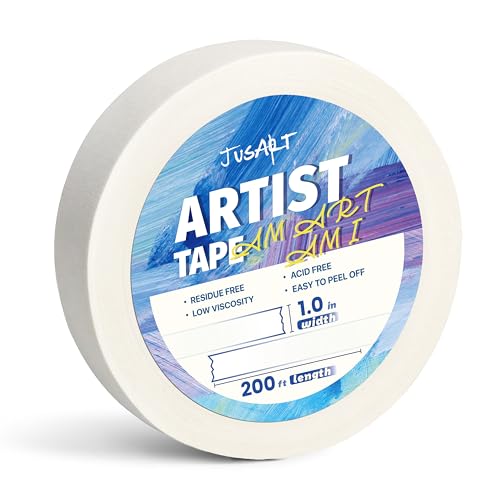
Best for: Painters who need a wider border for masking or framing. The tape is one inch wide and 200 feet long, making it a practical format for covering more area per strip than a half-inch option.
JusArt describes this product as low-tack, acid-free artist tape made from premium pulp. Its translucent cool-white finish is intended to make edges easier to see. The listing also says it adheres securely to watercolor paper borders, can be repositioned, and removes without residue while minimizing paper damage. It claims the tape helps prevent watercolor pigment from bleeding through the masked edge.
Choose this if your canvas project needs a broader masked margin or if you want one roll for painting, drafting, and framing tasks. Its width is the main advantage over the narrower JusArt version, while the shared low-tack description makes it more art-focused than ordinary construction masking tape.
Limitation: Bleed resistance is described for watercolor use; the listing does not establish how the tape performs with every paint type or on every canvas coating. Test before using it on finished work.
JusArt 0.5-Inch Artist Tape

Best for: Artists who need a narrow tape for borders, drafting, or fine masking. This version is one-half inch wide and 200 feet long, giving it the same stated length as the one-inch option in a slimmer format.
The product is described as acid-free, low-tack, and made from premium pulp. Its translucent cool-white surface helps keep the edge visible while placing the tape. JusArt says it can be repositioned, removes without residue, minimizes paper damage, and helps isolate watercolor pigment to reduce bleed-through.
Choose this if a one-inch strip would cover too much of the composition or if your project involves narrow lines around an artwork. It is better suited to precise masking than broad coverage. It was included because its width and artist-tape features match common needs for controlled canvas and paper work.
Limitation: A narrow strip covers less area per pass, so it may take more pieces to mask a large border. As with any adhesive, check its release on the particular surface before relying on it.
SmaringRobot Blue Painter’s Tape

Best for: Craft users who want general-purpose blue masking tape for labeling, light-duty sealing, or projects beyond fine art. The package contains four rolls listed as 0.94 inches wide and 22 yards long each.
The product is made from blue crepe paper and uses what the listing calls medium-adhesion glue. It is described as hand-tearable and suitable for smooth or lightly textured surfaces, including paper, glass, metal, tile, and plastic. The manufacturer also states that it resists sunlight, UV, heat, and moisture, and that it removes without residue when used as directed.
Choose this if you want a multipurpose tape that can serve for canvas-related crafts as well as household marking and masking. Its nearly one-inch width is useful for general borders, and four rolls provide more than one roll for ongoing projects.
Limitation: Unlike the dedicated artist tapes above, the listing does not describe this tape as acid-free. Avoid assuming it is suitable for long-term contact with valuable artwork, and test it before applying it to a painted canvas.
EFOK Eight-Width Pinstripe Tape Set

Best for: Artists and crafters who need several widths for fine-line designs, narrow borders, and broader masking. The set includes eight widths, from 1/12 inch to 2/5 inch, with 216 yards total according to the product name.
The tape is described as blue washi paper tape that tears by hand. The listing says it has firm adhesion during use and removes cleanly without residue or surface damage when applied to a clean, dry surface. Multiple widths make it easier to choose a strip close to the size of a line or design instead of cutting a wider tape down.
Choose this if your canvas work involves pinstriping, geometric patterns, or repeated lines in different widths. It offers more sizing options than a single-width artist roll, making it the most flexible pick for varied line work.
Limitation: The listing does not identify the tape as acid-free or specifically establish its performance on delicate canvas finishes. Test it first and avoid treating its clean-removal claim as a guarantee for every surface.
Buying Guide: How to Choose Painter’s Tape for Canvas
Should you choose artist tape or general-purpose painter’s tape?
For artwork, begin with the tape’s intended use and adhesive description. Artist tapes in this selection are marketed for watercolor paper, sketch paper, drafting, or canvas, and some are specifically described as acid-free or low-tack. Those details can matter when the tape sits close to an image or delicate paper edge.
General-purpose painter’s tape may be more versatile for household projects and craft tasks, but its surface-removal claims do not automatically mean it is appropriate for every artwork. If preserving a painted surface is important, use the least aggressive tape that will hold for the task, and test it before masking the main area.
What tape width works best for a canvas project?
- Half-inch tape: Better for narrow borders, fine masking, and smaller details. KIWIHUB and JusArt offer half-inch options.
- One-inch tape: Better for wider edges and general masking. The JusArt one-inch roll is an art-focused choice.
- Multiple narrow widths: Better when a project combines fine lines and slightly wider sections. EFOK provides eight stated widths from 1/12 inch to 2/5 inch.
- Nearly one-inch multipurpose tape: Better for general craft and household use where artist-specific features are not the main priority.
Wider tape can cover more area with fewer strips, while narrow tape gives finer control around small shapes. If you are unsure, choose a width that matches the intended border rather than relying on tape to create an edge narrower than the tape itself.
How important are acid-free and low-tack descriptions?
Acid-free is a useful product attribute to consider for art materials, especially when tape will be used near paper or artwork for framing and masking. It does not, by itself, guarantee that tape will release cleanly from every canvas surface. Low-tack describes a gentler hold, but the actual result can still vary with canvas texture, paint condition, dust, and the time the tape remains in place.
Read the product details carefully. KIWIHUB and both JusArt options are described as acid-free. JusArt also calls its artist tapes low-tack. The SmaringRobot and EFOK listings do not state that they are acid-free, so do not assume they share that feature.
How can you reduce the risk of lifting paint or leaving residue?
- Use a small, inconspicuous test area before masking a larger section.
- Make sure the surface is clean and dry; the SmaringRobot and EFOK listings specifically emphasize surface preparation.
- Press tape down only as much as needed to hold it in place, especially over delicate or textured areas.
- Remove the tape slowly and carefully rather than pulling it sharply away from the canvas.
- Do not leave tape on longer than the project requires, and follow any product-specific directions.
These precautions are practical safeguards, not guarantees. The products’ listed removal claims apply under their stated conditions, and canvas materials and paint finishes can differ.
What should you prioritize for watercolor painting?
For watercolor work, look for tape described for watercolor paper and check whether the listing mentions acid-free materials, low-tack adhesive, or pigment bleed control. JusArt’s listing specifically describes bleed resistance for watercolor pigment. KIWIHUB emphasizes use on watercolor and sketch paper, as well as canvas, and identifies the tape as acid-free.
Canvas painting may involve different paint types and surface coatings, so watercolor-specific claims should not be treated as proof of performance with acrylics, oils, or other media. Choose tape according to the surface and paint involved, then test first.
Which option is best for detail work versus general masking?
For fine lines in different sizes, EFOK’s assortment is the most width-flexible choice in this group. For a narrow, single-width artist tape, the half-inch JusArt or KIWIHUB roll is more direct. For a wider art-oriented strip, choose the one-inch JusArt option. For general labeling, crafts, and light-duty masking, SmaringRobot provides a multipurpose blue tape option.
Frequently Asked Questions
Can painter’s tape be used on canvas?
Yes, some tapes are marketed for canvas, including the KIWIHUB artist tape in this selection. However, canvas texture, paint condition, and coating can affect adhesion and removal. Test the tape on a small area before using it on finished work.
Is painter’s tape the same as artist tape?
Not necessarily. Painter’s tape is often marketed for general masking, while artist tape may be designed for paper, drafting, or artwork. Check each product’s stated uses and adhesive characteristics rather than relying only on its name.
Which tape is best for a narrow canvas border?
A half-inch option is a practical starting point for a narrow border. The KIWIHUB and JusArt tapes in this selection are both half an inch wide, but their stated features differ, so compare the descriptions and test the surface.
Does acid-free tape guarantee damage-free removal?
No. Acid-free describes an attribute of the tape material, not a guarantee that it will release from every surface without damage. Adhesion, surface texture, paint condition, and application time can affect removal.
How do I prevent paint from bleeding under tape?
Apply tape to a clean, dry surface and press it down carefully along the edge. Some products claim bleed resistance for specific uses, such as watercolor on paper, but results can vary by surface and paint. Test the tape and paint combination first.
Should I leave tape on a canvas overnight?
Do not assume a tape is safe to leave on canvas for a set period unless its product directions support that use. Remove masking when it is no longer needed, and test beforehand if the project requires extended application.


