The best epoxy paint spray gun depends on the coating’s technical instructions, its viscosity, and the air supply or power available. For an air-compressor setup, the ENDOZER HVLP set is a flexible choice with three nozzle sizes; the AEROPRO LVLP gun is better for users seeking lower air consumption. The cordless sprayer suits portable DIY work, but its product details do not specifically confirm epoxy compatibility. Always check the epoxy manufacturer’s directions before spraying.
| Product | Best For | Type |
|---|---|---|
| ENDOZER Professional HVLP Set | Multiple nozzle options | HVLP air gun |
| AEROPRO Tools R500 LVLP | Lower air consumption | LVLP air gun |
| 819 HVLP Air Spray Gun Kit | Adjustable settings | HVLP air gun |
| GATTLELIC HVLP Spray Gun | Mixing cups and regulator | HVLP air gun |
| ToCzernobgol Cordless Sprayer | Portable household projects | Electric sprayer |
ENDOZER Professional HVLP Spray Gun Set
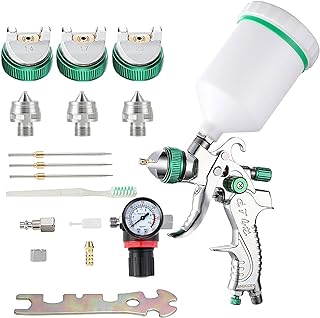
Best for: Buyers who want an air-powered gun with several nozzle sizes for testing against a coating’s specified application requirements. The set includes 1.4, 1.7, and 2.0 mm stainless-steel nozzles and needles, plus a 20-ounce (600 cc) gravity-feed cup.
Fluid, pattern, and air controls let the operator adjust paint output, fan size, and airflow. Its brass air cap has 15 holes, and the gun has a 1/4-inch NPT inlet with a matching quick adapter. These features make it a versatile option for automotive paint, primer, clear coat, and touch-up work as described by the product listing.
Why it was selected: The three included nozzle sizes provide a choice of setups, which can be useful when an epoxy coating’s technical data sheet specifies a particular tip range. Limitation: The listing says not to use latex paint and does not confirm compatibility with every epoxy formula. Check the coating instructions and clean the gun as directed after use.
AEROPRO Tools R500 LVLP Spray Gun

Best for: Users whose compressor setup benefits from lower stated air consumption than a typical HVLP option. The listing gives an air-use range of 3.0–3.9 CFM and an operating pressure range of 2.0–3.5 bar.
This LVLP gun comes with 1.3, 1.5, and 1.7 mm nozzles and an air regulator. A two-stage trigger provides a dust-cleaning setting followed by the painting setting. The product information also describes a 280 mm spray width and a Teflon-coated exterior intended to resist wear and dirt.
Why it was selected: Its lower stated air-volume requirement makes it worth considering when compressor capacity is a key purchasing factor. The multiple nozzle sizes offer options to compare with the epoxy manufacturer’s application guidance. Limitation: The listing discusses automotive paint, furniture, varnish, and top coat, but does not specifically verify epoxy use. Confirm the required pressure, tip size, and material suitability before buying.
819 HVLP Air Spray Gun Kit

Best for: Buyers who want an HVLP gun with three included nozzle options and adjustable material, fan, and airflow controls. The kit includes 1.3, 1.7, and 2.0 mm nozzles, plus an air regulator separator.
The stated working pressure is 2.0–3.5 bar, the listed air consumption is 3.0–3.9 CFM, and the recommended spray distance is 200–300 mm. The product description identifies automotive refinishing, wall painting, roof repair, and industrial spraying among its possible uses, and says it is suitable for various water-based and solvent-based coatings.
Why it was selected: The adjustable controls and multiple tips give users several setup choices to compare with coating instructions. It may suit a buyer who wants one air gun for more than one type of project. Limitation: “Various” coating types does not establish compatibility with a particular epoxy. Verify the product’s material requirements and confirm that the compressor can meet the gun’s pressure and air-volume needs.
GATTLELIC HVLP Spray Gun With Cups

Best for: Buyers who want a regulator and disposable mixing cups included with an air-powered HVLP gun. The package description lists ten 600 cc mixing cups and lids, a regulator with a reusable filter, and 1.4, 1.7, and 2.0 mm nozzles.
The stated operating pressure is 2.5–3.5 bar, and the listed air consumption is 275 L/min. The gun has a 600 cc paint capacity, a 240 mm spray width, and a 1/4-inch NPT inlet. Its adjustable controls are described as regulating paint amount, spray amplitude, and airflow. The brass cap has a 15-hole design.
Why it was selected: The supplied cups and regulator make this a practical option for buyers who want mixing and air-pressure accessories in the same kit. Its nozzle range gives some setup flexibility. Limitation: Product claims about paint utilization do not guarantee a specific result with epoxy. The listing does not name epoxy as a confirmed coating, so check the coating data sheet and the gun manufacturer’s instructions.
ToCzernobgol Cordless Electric Paint Sprayer

Best for: DIY users prioritizing portability for furniture, cabinets, fences, walls, and similar household projects. This electric sprayer has a 1,200 ml capacity, five listed nozzle sizes from 1.0 to 3.0 mm, three spray patterns, and adjustable flow control.
The kit includes two 4.0 Ah batteries. The listing estimates 20–25 minutes of spraying per battery and describes a quick-swap design. Horizontal, vertical, and diagonal spray patterns provide choices for different work surfaces.
Why it was selected: It offers cordless operation and several nozzle options for small or mobile projects where an air compressor is inconvenient. Limitation: The product details do not state that this sprayer is suitable for epoxy. Do not assume that an electric household sprayer can handle a particular two-part or viscous epoxy; confirm material compatibility, viscosity limits, and cleanup instructions first. Its battery runtime also makes it less suited to extended continuous work.
Buying Guide: How To Choose An Epoxy Paint Spray Gun
Does the product listing confirm epoxy compatibility?
Not necessarily. The products above describe use with automotive coatings, primers, clear coats, varnish, or general paints, but those descriptions do not confirm compatibility with every epoxy. Epoxy products vary in viscosity, mixing instructions, pot life, and application method. Check the coating’s technical data sheet and the spray gun instructions before using them together.
Pay particular attention to whether the epoxy can be sprayed, whether thinning is permitted, and which tip size and pressure are recommended. Do not thin a coating unless its manufacturer allows it. Some epoxy systems are designed for rolling, brushing, or specialized equipment rather than a general-purpose spray gun.
Which nozzle size should you choose?
Use the nozzle size specified by the coating maker whenever possible. A smaller tip may not pass a thicker material effectively, while a larger tip can deliver more material than desired. The included options differ across these products: the ENDOZER and GATTLELIC sets include 1.4, 1.7, and 2.0 mm tips; the AEROPRO includes 1.3, 1.5, and 1.7 mm; the 819 kit includes 1.3, 1.7, and 2.0 mm.
Having several tips is useful only if one matches the coating requirements. Nozzle size alone does not establish suitability; pressure, viscosity, spray technique, and the gun’s design also matter.
Should you choose HVLP, LVLP, or cordless?
HVLP models use an air compressor and are represented by the ENDOZER, 819, and GATTLELIC guns. Compare their stated pressure and air-consumption requirements with your compressor’s output. A compressor that cannot supply enough air may not operate the gun as intended.
LVLP describes the AEROPRO option, which lists lower air consumption and pressure ranges. That can be a relevant distinction for buyers comparing compressor demands, but the compressor must still meet the stated requirements.
Cordless electric equipment avoids an air hose and compressor, but the listed ToCzernobgol sprayer does not confirm epoxy use. For epoxy, prioritize material compatibility over convenience or portability.
What controls and accessories matter?
Fluid control adjusts material output, pattern control changes the fan width, and an air control adjusts airflow on air-powered guns. These settings help an operator configure the spray, but they do not replace the coating maker’s application directions. A regulator can help manage pressure, while mixing cups can support preparation; confirm that included accessories fit your workflow.
- Check the gun’s inlet size and the air fittings required for your setup.
- Compare pressure and air-consumption specifications with the compressor.
- Confirm the cup capacity is appropriate for the amount you plan to mix.
- Review cleaning instructions, especially for coatings that cure after mixing.
- Use the coating’s specified protective equipment and ventilation practices.
How should you compare these five options?
Choose the ENDOZER or 819 if a three-tip HVLP kit is your priority. Consider the GATTLELIC if the included cups and regulator match your needs. The AEROPRO is the LVLP choice in this group and lists a lower air-volume range. The cordless model is aimed at portable household spraying, not confirmed epoxy application. In every case, the coating instructions and equipment compatibility should determine the final choice.
Frequently Asked Questions
Can I spray epoxy paint with any of these guns?
Not based on the supplied product details alone. The listings do not confirm suitability for every epoxy. Check the specific coating’s technical data sheet and the spray gun’s material instructions before spraying.
What nozzle size is best for epoxy?
There is no universal size for all epoxy coatings. Follow the coating manufacturer’s specified tip range, viscosity instructions, and application method. The nozzle options listed for these guns vary from 1.3 to 2.0 mm, with the cordless model offering sizes up to 3.0 mm.
Do I need an air compressor for an HVLP or LVLP spray gun?
Yes. The HVLP and LVLP models listed here are air-powered and require a suitable compressor. Compare the gun’s pressure and air-consumption requirements with the compressor’s available output.
Is the cordless sprayer a confirmed epoxy paint sprayer?
No. Its listed features describe household and DIY painting uses, but do not specifically confirm epoxy compatibility. Ask the manufacturer or consult the epoxy instructions before using it for that coating.
Can epoxy be thinned to fit a spray gun?
Only if the epoxy manufacturer specifically permits thinning and provides directions. Unapproved thinning can change how the coating applies or performs. Follow the product’s technical data sheet rather than guessing.


