The best knockdown texture roller depends on whether you need to spread drywall compound or imprint a decorative pattern into a thick, wet coating. For decorative work, the 7-inch rubber rollers below offer reusable patterned surfaces; for applying joint compound, the 9-inch PinStone cover is the more suitable choice. Match the roller to the material and finish: these products are not all interchangeable, and several are specifically unsuitable for ordinary thin paint.
| Product | Best For | Key Distinction |
|---|---|---|
| 2-piece 7-inch rubber roller | Thick coatings and decorative patterns | Two rollers; steel wire reinforcement |
| BANCOO 7-inch texture roller | Choosing from multiple pattern styles | More than 20 patterns offered |
| 2-piece silicone texture roller | DIY projects on varied surfaces | Two rollers and ergonomic handle |
| Nichiyo 7-inch texture roller | Embossed wall patterns | Calls for thick, slow-moving coatings |
| PinStone 9-inch compound covers | Spreading drywall joint compound | Designed for standard 9-inch frames |
2-Piece 7-Inch Rubber Texture Roller

This set contains two 7-inch rollers made from durable rubber with steel wire reinforcement. The listed use is creating decorative patterns with thick slurry or elastomeric coatings, including on walls, ceilings, furniture, and cabinets.
- Best for: Decorators who want two rollers for pattern work with suitable thick coatings.
- Why it was selected: The material and stated coating use align with decorative texture applications rather than ordinary paint application.
- Limitation: The listing says it is not a standard interior-wall, drywall, or ceiling paint roller. It also recommends the tool for experienced decorators.
Choose this set if you already know how to work with thick texture materials and want a reinforced rubber pattern roller. Avoid it if your main task is rolling thin wall paint or simply spreading joint compound.
BANCOO 7-Inch Patterned Texture Roller

The BANCOO roller has a 3D-engraved rubber surface for imprinting patterns into wet art paint. The listing offers more than 20 pattern choices, with each roller measuring 7 inches. It is described as washable and reusable.
- Best for: DIY decorators who want to select a pattern style from a broad assortment.
- Why it was selected: Pattern choice is its distinguishing feature, and its embossed rubber surface is intended for decorative wall work.
- Limitation: The listing calls for textured art coatings and says buyers should understand the process before starting. It does not identify this as a general-purpose roller for thin paint.
Choose this option if pattern selection matters and you are prepared to practice the application process. The product information suggests testing on a small PVC board first, which can help you learn how the coating and roller behave before working on a finished wall.
2-Piece Silicone Texture Roller Set
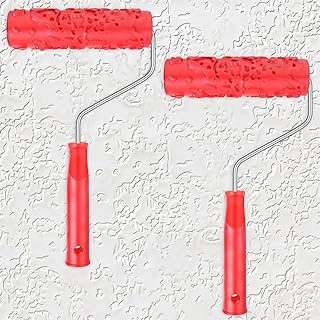
This set includes two identical 7-inch rollers made with silicone, ABS, and stainless steel. The listing describes an ergonomic ABS handle and use with thick slurry elastomeric coatings, texture mediums, plaster, glazes, and slow-drying paints. It names walls, floors, furniture, fences, and decks as possible project surfaces.
- Best for: DIY users seeking a two-piece set for decorative work across different surfaces.
- Why it was selected: The stated range of wet materials and surfaces makes it a flexible option for projects beyond a single interior wall.
- Limitation: It is intended to imprint wet material, not to replace a standard roller for routine thin-paint coverage. Pattern results depend on using a suitable medium.
Choose this set if you value having two rollers and an ergonomic handle for extended work. Before starting, confirm that your selected coating is suitable for imprinting and that its working time allows you to roll the pattern while it is wet.
Nichiyo 7-Inch Embossed Texture Roller

Nichiyo’s 7-inch roller uses flexible rubber to create embossed patterns on drywall, plaster, and painted surfaces. The product is described as a DIY tool for adding a textured finish that may help disguise cracks, dents, or old paint.
- Best for: Home decorators who want a single rubber roller for patterning suitable wall coatings.
- Why it was selected: Its listed surfaces and decorative purpose directly match wall texture projects.
- Limitation: Thick slurry elastomeric coatings or heavy paste paints are recommended. Thin, runny, or quick-drying paints may create weak, incomplete, or blurred textures.
Choose this roller if you can use a thick coating and want to test a decorative finish on a wall or plaster surface. The listing recommends trying the chosen paint on a scrap surface before committing to the main project.
PinStone 9-Inch Drywall Compound Covers

Unlike the embossed rubber pattern tools, these two 9-inch covers are designed to spread drywall mud and joint compound. They have a 1/2-inch nap made from tightly woven nylon, and the listing says they fit standard U.S. 9-inch roller frames.
- Best for: People applying joint compound to walls, ceilings, or drywall repair areas.
- Why it was selected: It addresses the compound-spreading step that may be part of a drywall texturing project, rather than decorative embossing.
- Limitation: These are compound roller covers, not 7-inch patterned rollers. They apply material but are not listed as tools for imprinting decorative designs.
Choose this product if your goal is to roll joint compound onto a surface before a separate finishing step. The covers require a compatible 9-inch frame, which is not stated to be included.
Buying Guide: How to Choose a Knockdown Texture Roller
“Knockdown texture roller” can refer to different tools and stages of a wall project. Some rollers apply drywall mud or compound; others press a pattern into a wet coating. These are different jobs. Decide what result you want before choosing a roller, then compare the listed material, width, handle or frame needs, and recommended coating.
Do you need to apply compound or imprint a pattern?
For spreading joint compound, choose a roller cover made for drywall mud, such as the 9-inch PinStone covers. For pressing an embossed design into wet material, consider one of the 7-inch rubber or silicone pattern rollers. A pattern roller is not automatically a suitable tool for applying ordinary paint or distributing compound over a large area.
If your project involves both steps, you may need separate tools: one for applying material and another for shaping or texturing it. Confirm that the tool you choose matches the specific stage you plan to complete.
Which coating works with a patterned roller?
Check the product instructions for coating type before buying. Several of the 7-inch rollers call for thick slurry, elastomeric coating, heavy paste, plaster, or other texture mediums. The Nichiyo listing specifically cautions that thin, runny, or quick-drying paint can produce weak or blurred impressions.
Do not assume that a roller designed for thick material will work well with standard wall paint. If you are unsure about your coating, test it on a scrap surface first. A test lets you check whether the pattern forms clearly and whether the material stays workable long enough to complete the pass.
Should you choose rubber, silicone, or a nap cover?
Rubber and silicone pattern rollers have shaped surfaces intended to leave impressions. The listed rubber options include durable or flexible construction, while the two-piece silicone set includes an ABS handle. The PinStone covers have a nylon nap for spreading compound rather than creating an embossed design.
Choose based on the task, not just the material name. A rubber roller with a pattern is intended to imprint wet material; a nap cover is designed to carry and spread it. Also check whether a roller is sold individually or in a set if you need a specific quantity.
How wide should the roller be?
The patterned rollers here are 7 inches wide, while the compound covers are 9 inches. A 7-inch tool may suit decorative work where controlled patterning is the priority. A 9-inch cover is sized for a standard 9-inch roller frame and is intended for applying drywall compound.
Width alone does not establish which tool is better. Compare the roller’s intended use, the project surface, and any required frame or handle. The PinStone listing specifies a standard U.S. 9-inch frame, while the 7-inch listings describe pattern rollers.
How can you prepare for a more consistent finish?
- Read the product’s instructions and identify the recommended coating before opening the material.
- Practice on a scrap board or inconspicuous area to check the texture and rolling process.
- Use a coating with a suitable consistency and working time for the roller design.
- Plan the surface area and work sequence so the material does not dry before the pattern is applied.
- Clean reusable rollers according to the material and product guidance after use.
Practice is especially useful for patterned tools because pressure, pace, and the condition of the wet material can affect how clearly a design appears. The product listings do not specify a single application technique or coating recipe that works for every surface.
What should you check before ordering?
Confirm whether the listing describes a complete roller, a pair of rollers, or replacement covers. Check the roller width, construction, and stated surface or coating uses. For compound covers, verify that you have the required roller frame. For patterned rollers, verify that you have an appropriate thick or textured medium rather than assuming the tool works with regular paint.
Also compare the feature that matters most for your job: pattern variety, a two-piece set, reinforced construction, a stated ergonomic handle, or suitability for spreading drywall mud. These differences are more useful than treating every product labeled “texture roller” as equivalent.
Frequently Asked Questions
Can a knockdown texture roller be used with regular wall paint?
Not necessarily. Several patterned rollers are intended for thick coatings, texture mediums, or heavy paste. The 2-piece 7-inch roller listing specifically says it is not a standard paint roller, and the Nichiyo listing warns against thin or quick-drying paint.
Are the 7-inch rollers the same as drywall compound rollers?
No. The 7-inch products are patterned rollers for imprinting wet material. The 9-inch PinStone covers are intended to spread drywall mud or joint compound and fit a standard U.S. 9-inch frame.
Which option is best for spreading joint compound?
The PinStone 9-inch covers are the product in this selection specifically described for spreading drywall mud and joint compound. They are not described as embossed pattern rollers.
Should I test the roller before texturing a wall?
Yes. A scrap surface lets you check the coating, pattern, and rolling process before working on the main area. The BANCOO listing suggests practicing on a small piece of PVC board, and Nichiyo recommends testing the chosen paint on a scrap surface.
Can patterned texture rollers be reused?
Some listings describe their rollers as reusable or washable. BANCOO states that its 7-inch roller is washable and reusable. Follow the product’s cleaning guidance and remove compatible coating before it hardens.


