The best primer for a plywood floor depends on the flooring material and adhesive being installed: choose a flooring-specific primer when its label matches the project, rather than assuming a general-purpose wall primer is suitable. Henry H336 and ROBERTS FS400 are intended for flooring installation preparation; FloorPops primer is specifically for its peel-and-stick tiles. Zinsser Bulls Eye 1-2-3 and 1-2-3 Plus are general-purpose primers, so verify that their labels approve the intended floor use before applying them to plywood.
| Product | Best suited for | Key distinction |
|---|---|---|
| Henry H336 Bond Enhancer | Flooring installations needing a specialized liquid latex primer | Floor-covering installation use |
| ROBERTS FS400 | Preparing dry, porous substrates for flooring adhesive | Ready to use; no dilution |
| FloorPops Peel Stick Tile Primer | FloorPops peel-and-stick tiles | Use full strength |
| Zinsser Bulls Eye 1-2-3 | Projects where an all-surface stain-blocking primer is appropriate | Interior and exterior use |
| Zinsser 1-2-3 Plus | General interior or exterior latex priming where label directions fit | Listed as an interior/exterior latex primer |
Henry H336 Bond Enhancer

Henry H336 is a specialized liquid latex primer described for a wide range of floor-covering installation uses. That focus makes it a more relevant starting point for a flooring project than a general-purpose paint primer, especially when the flooring or adhesive manufacturer specifies a compatible primer.
Best for: Installers or homeowners preparing for a floor-covering installation who need a flooring-oriented primer and can confirm that H336 is approved for their plywood, adhesive, and finish-floor system. It is selected because the provided product information explicitly identifies floor-covering installation as its intended application.
Check before buying: The listing does not state which plywood grades, flooring materials, or adhesives it supports, nor does it provide application or drying instructions. Do not assume that “wide range” means universal compatibility. Follow the product label and the flooring and adhesive manufacturers’ instructions.
ROBERTS FS400 First Step Primer

ROBERTS FS400 is a ready-to-use, single-component acrylic latex primer. Its listed purpose is to prepare dry substrates for better adhesive performance and to help flooring adhere to porous substrates. The product information says no dilution is necessary.
Best for: A flooring installation over a dry, porous substrate when the flooring or adhesive maker approves FS400 for the specific surface. It is a practical candidate for comparison with H336 because its stated use directly concerns substrate preparation and flooring adhesion.
Choose this if: You want a primer supplied ready to use and do not want to mix or dilute it. The listing identifies a one-gallon product, which may be more relevant for a larger area than a small repair, but check the label for coverage and application requirements.
Limitation: The listing does not specifically confirm plywood compatibility. It also does not provide a coverage rate, drying time, or approved adhesives. Confirm those details before using it on a plywood floor.
FloorPops Peel Stick Tile Primer

FloorPops FPP4182W is a latex floor primer made for FloorPops peel-and-stick floor tiles. The listed preparation requirements are important: the surface must be sound, dry, clean, and free of contaminants. The primer should be used at full strength and not diluted.
Best for: A buyer installing FloorPops peel-and-stick tiles who wants the primer specified for that product family. This is the clearest match among these options for a named peel-and-stick tile installation.
For plywood: Do not infer approval for every plywood subfloor from the term “floor primer.” Check the FloorPops and primer instructions to confirm that the plywood surface is acceptable and determine any preparation steps. The listed cleanliness and dryness requirements still apply.
Limitation: This primer is described for FloorPops tiles, not as a universal primer for flooring adhesives or other finish floors. Avoid choosing it for a different flooring system unless that system’s manufacturer approves it.
Zinsser Bulls Eye 1-2-3 Primer
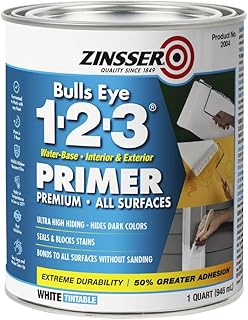
Zinsser Bulls Eye 1-2-3 is a water-based, all-surface stain-blocking primer and sealer listed for interior and exterior use. Its listed features include bonding to glossy surfaces without scuff sanding and application at temperatures as low as 35°F.
Best for: A project where the product label confirms that the intended surface and subsequent coating are appropriate uses. It may be useful when stain blocking or priming a glossy surface is relevant, but those features alone do not establish suitability beneath flooring.
Why it is included: It is a widely described general-purpose primer with useful surface-bonding and stain-blocking features. It gives buyers a comparison point against the products specifically described for flooring installations.
Limitation: The provided features do not identify plywood subfloors, floor adhesives, or finish flooring as approved applications. Do not use it under flooring solely because it is called an all-surface primer; verify the label and flooring-system requirements first.
Zinsser Rust-OLEUM 1-2-3 Plus

This product is listed as an interior/exterior latex primer, with a simple-use kit description. The listing also states that it is manufactured in the United States. The available information does not specify flooring installation, plywood subfloors, or compatibility with particular adhesives.
Best for: Buyers comparing a general-purpose latex primer for an application explicitly permitted by its label. It is included as a general-purpose alternative, not as a confirmed flooring primer.
Choose this if: The project involves a surface or coating use allowed by the product label and the flooring system does not require a different primer. Check the package for the full application directions, since the provided product details do not explain plywood preparation or installation conditions.
Limitation: Do not treat its interior/exterior description as proof that it can go beneath flooring. Confirm flooring and adhesive compatibility before applying it to a plywood subfloor.
Buying Guide: How to Choose Primer for a Plywood Floor
What flooring are you installing?
Start with the finish-floor product, not the primer aisle. Peel-and-stick tiles, sheet flooring, tile, and other flooring systems can call for different substrate preparation. A primer designed for a named product, such as FloorPops primer for FloorPops tiles, is not automatically suitable for another floor covering. Check the flooring maker’s installation instructions for approved primers and substrate requirements.
Does the primer specifically support plywood?
Plywood is not a single uniform surface. Its condition, surface contamination, seams, and exposure to moisture can affect preparation. A product description that mentions porous substrates or floor-covering installations does not necessarily confirm every plywood type or installation. Look for explicit plywood or wood-subfloor directions on the label, and contact the manufacturer if the instructions are unclear.
Does the adhesive maker require a primer?
Some installations use a particular adhesive and primer combination. The adhesive instructions may identify acceptable substrates, application methods, and whether primer is required. Choose a primer only when it is compatible with both the plywood and the adhesive. Using an unrelated general-purpose primer can create a layer that the adhesive manufacturer has not approved.
Is the plywood ready to prime?
Follow the flooring system’s preparation instructions. The surface generally needs to meet the product’s stated requirements for dryness, cleanliness, soundness, and freedom from contaminants. FloorPops specifically lists those conditions for its primer. Do not cover loose, damaged, dirty, or damp material without addressing the issue according to the relevant product directions.
Should you choose ready-to-use or concentrated primer?
ROBERTS FS400 is listed as ready to use with no dilution necessary, while FloorPops primer is listed for full-strength use. For any product, follow the package directions rather than changing its concentration. The provided details for Henry H336 do not specify whether it needs dilution, so confirm the label before use.
How do you compare the five options?
| Decision point | What the listed information supports | What to verify |
|---|---|---|
| Floor-covering installation | Henry H336 is described as a specialized primer for floor-covering installations. | Approval for the exact plywood, adhesive, and flooring combination. |
| Dry, porous substrates | ROBERTS FS400 is intended to prepare dry substrates and porous surfaces for flooring adhesion. | Plywood approval, coverage, and drying directions. |
| FloorPops peel-and-stick tiles | FloorPops primer is specifically described for FloorPops tiles. | Whether the plywood condition and installation meet the tile instructions. |
| General-purpose priming | Zinsser Bulls Eye 1-2-3 and 1-2-3 Plus are listed as general-purpose primers. | Whether use beneath the selected flooring is expressly allowed. |
Compare the complete label instructions, not just the product name. Pay attention to substrate restrictions, surface preparation, application temperature, dilution, drying time, and the products that may be applied over the primer. The listings provided do not supply all these details for every option.
When should you avoid a general-purpose primer?
Avoid substituting a paint-oriented primer for a flooring-specific product when the flooring or adhesive instructions call for a particular primer. Stain blocking, interior/exterior use, and adhesion to glossy surfaces do not by themselves demonstrate suitability beneath flooring. When no clear compatibility statement is available, ask the product manufacturer or flooring installer before proceeding.
Frequently Asked Questions
Can you use primer on a plywood floor before installing flooring?
Yes, when the flooring and adhesive instructions call for or allow a primer that is approved for the plywood surface. Confirm compatibility before application; not every general-purpose primer is suitable beneath flooring.
Which listed primer is specifically made for peel-and-stick floor tiles?
FloorPops FPP4182W is listed as a latex primer for FloorPops peel-and-stick floor tiles. Its instructions say the surface must be sound, dry, clean, and free of contaminants, and that the primer should not be diluted.
Is ROBERTS FS400 ready to use?
Yes. Its listing describes it as a ready-to-use, single-component acrylic latex primer that requires no dilution.
Does Zinsser Bulls Eye 1-2-3 work under every type of flooring?
The provided product information does not establish that. It describes an all-surface stain-blocking primer, but buyers should confirm the label permits the specific floor, adhesive, and plywood application.
Can primer fix damaged or damp plywood?
Do not assume primer will repair damaged or damp plywood. Follow the flooring system’s substrate requirements and correct unsuitable surface conditions before installation. The listed FloorPops primer, for example, requires a sound and dry surface.
Should primer be diluted before use?
Follow the product label. ROBERTS FS400 is listed as requiring no dilution, and FloorPops primer is listed for use at full strength. The supplied details do not specify dilution instructions for every product.


