Direct answer: For professional-grade wood sanding, choose machines with high RPM, low vibration, and dust collection for cleaner work and longer blade life. This guide features five top options suited to serious hobbyists, carpenters, and finishing specialists. Each pick targets different tasks—from detailed 1/4 sheet sanding to aggressive material removal—so you can match the tool to your project and environment. The following sections explain who each sander fits best and why it was selected, along with practical cautions to consider.
Summary table of selected products:
| Product | Best For | Key Benefit |
|---|---|---|
| SKIL 5” Random Orbital Sander | General-purpose sanding; beginners to intermediate | Cyclonic dust box and variable speed |
| DEWALT DWE6423 Random Orbit Sander | Comfort-focused, prolonged use | Low vibration; dust-sealed switch |
| DEWALT DWE6411 1/4 Sheet Sander | Detail work and edge sanding | High OPm and secure paper clamp |
| 64 PCS Hook & Loop Sanding Discs | Versatile surface prep and finishing | Wide grit range for drills and detail work |
| DEWALT DWE6421K Orbital Sander Kit | Comprehensive kit for pros | High OPM with vibration control |
SKIL 5” Random Orbital Sander with Cyclonic Dust Box

The SKIL SR211601 is a versatile random orbital sander designed for mid-range woodworking tasks. It features a 2.8-amp motor delivering up to 13,000 OPM, enabling smooth material removal across a variety of surfaces. The integrated cyclonic dust box helps keep workpieces cleaner by separating dust from the sanding chamber, while the transparent container makes dust levels easy to monitor. A variable speed control allows adapting power to different materials and finishes.
Best for: Hobbyists and pros who need a balanced, affordable sander with reliable dust collection. It’s especially suitable for general finishing and paint prep on medium-density woods. Clear advantage lies in the cyclonic dust box and adjustable RPM for different materials.
Limitations: As with many entry-to-mid-range tools, the vacuum efficiency depends on the dust system’s fit to the project and paper quality. Avoid this if you require extremely silent operation or heavy, continuous use without breaks.
DEWALT Random Orbit Sander, 5-Inch, DWE6423
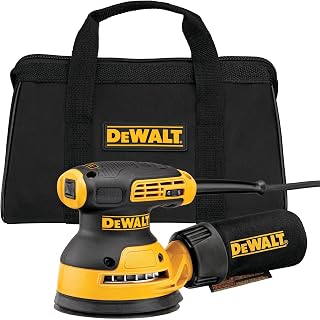
The DEWALT DWE6423 offers a 3-amp motor with 8,000 to 12,000 OPM, making it a robust option for mid- to heavy-duty sanding. Its separate counterweight design reduces vibration, which improves user comfort during longer sessions. An enhanced dust-sealed switch provides longevity by resisting dust ingress, a common issue in busy shop environments. This sander is well-suited for professionals who want steadier control and consistent results across larger surfaces.
Best for: Professionals who value reduced vibration and longer switch life, especially on large project runs where comfort and control matter. It’s a solid choice when you need dependable performance over hours of work.
Limitations: It prioritizes performance over ultra-lightweight form; for very precise, fine-detail work, a smaller or lower-vibration model might be preferable.
DEWALT Electric Sander, 1/4 Sheet (DWE6411)

The DEWALT DWE6411 is a 2.3-amp electric sander designed for 1/4 sheet applications at up to 14,000 OPM. Its rubber overmold texture provides comfortable grip and control, while an improved paper clamp helps with secure paper retention during aggressive sanding. This model is ideal for precise edge work and curved surfaces where larger compact sanders may not reach effectively.
Best for: Woodworkers needing finer control around irregular shapes, edges, and contours. Choose this if you frequently work on picture frames, moldings, or curved surfaces.
Limitations: The smaller size limits aggressive material removal on flat, large panels compared to larger orbital sanders.
DEWALT Orbital Sander Kit

The DEWALT DWE6421K Orbital Sander Kit combines a 3.0-amp motor with a higher sanding speed of up to 12,000 OPM. It uses a compact height to improve access to tight spaces while maintaining a separate counterweight design to reduce vibration. This kit is a solid choice for professionals who need a reliable, all-around sander that can handle detailed work and larger surface areas with equal competence.
Best for: Pros seeking a comprehensive kit for versatile shop use, including edges and curves. It’s ideal when you need a balance between control and productivity in a single tool.
Limitations: The additional weight of a kit setup may be less ideal for extended handheld sessions compared to lighter, streamlined models.
Buying Guide
Key purchase considerations for professional wood sanding:
- Purpose and scope: Choose based on project type—large surfaces benefit from orbital or random orbital sanders; edges and contours benefit from 1/4 sheet or detail sanders.
- Oscillation speed (OPM) and power: Higher OPM supports faster material removal, but slower speeds allow finer finishing; select variable speed when finishing different woods.
- Dust collection: Effective dust management improves visibility and health; cyclonic and integrated bags help keep debris contained.
- Vibration and comfort: Counterweights, grip design, and weight affect fatigue during long sessions; consider models with vibration reduction.
- Paper retention and accessories: A secure paper clamp system reduces slipping; compatible discs and extra grits expand usability.
- Ergonomics for extended use: Shorter bodies and comfortable handles reduce fatigue; consider tool balance and grip texture for stability.
Frequently Asked Questions
- What sanding disc grits should I start with for bare wood? – Start with 60–80 grit for initial material removal, then move to 120–180 grit for smoothing, and finish with 220–320 grit for a fine surface.
- Is a dust collection system essential for professional sanding? – Yes, it improves air quality, keeps grooves visible, and reduces mess, especially on finishing projects.
- When should I use a 1/4 sheet sander vs a random orbital sander? – Use 1/4 sheet for edges and detailed work; use random orbital for flat surfaces and faster material removal without leaving swirl marks.
- How important is vibration reduction for long sanding sessions? – Very important; lower vibration reduces fatigue and helps maintain control, especially on large projects.
- Can I use the same sanding discs across different tools? – Many discs are standard hook-and-loop types, but verify disc size, backer compatibility, and attachment style for each tool.
- Are cordless sanders better for portability? – Cordless models offer mobility, but corded sanders typically provide consistent power for longer sessions and higher RPMs.