Looking for a reliable dual action sander to smooth wood, metal, or plastic surfaces? This guide highlights five top corded and cordless models that balance power, control, and dust management for different buyers. Each pick is labeled for its best-use scenario so you can choose with confidence. The following table summarizes the five products and why they’re a strong fit for specific tasks or skill levels.
| Product | |||
|---|---|---|---|
| SKIL SR211601 | Corded, 5” Orbital | Budget-friendly DIY projects | Cyclonic dust container and variable speed |
| DEWALT DWE6423 | Corded, 5” Orbital | Vibration-sensitive users | Low vibration and durable dust-sealed switch |
| DEKOPRO 5” Sander | Corded, 5” Orbital | Value with extras | Six speeds and included dust system |
| CRAFTSMAN CMCW220B | Cordless, 5” Orbital | Mobility with cordless freedom | Part of the V20 system with solid dust collection |
| HYCHIKA 5” Sander | Corded, 5” Orbital | Versatile, everyday finishing | 13000 RPM, six speeds, efficient dust bag |
SKIL 5” Random Orbital Sander with Cyclonic Dust Box

Best for budget DIY projects requiring decent dust control. The SKIL SR211601 runs on a 2.8-amp motor delivering up to 13,000 OPM for smooth stock removal on wood and light metals. Its cyclonic dust box is easy to empty, supporting cleaner work areas. The variable speed capability helps adapt the sanding aggressiveness to different materials. This model excels for hobbyists who need a reliable, affordable tool with straightforward maintenance.
Aim for: beginners or homeowners tackling furniture refinishing, cabinet touch-ups, or hobby projects. Limitation: not designed for heavy-duty commercial use or long-hour sessions.
DEWALT Random Orbit Sander, 5-Inch (DWE6423)
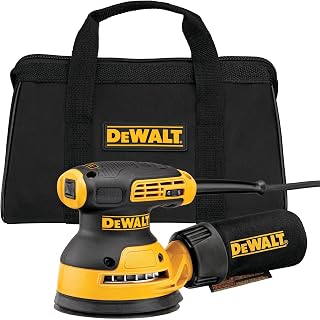
Best for users sensitive to vibration who still want strong performance. This model features a 3-amp motor with an 8,000–12,000 OPM range and a separate counterweight to reduce vibration, improving comfort during longer sessions. The dust-sealed switch helps protect internal components from dust intrusion, potentially extending the sander’s life. Choose this if you value smoother operation and longer wear between maintenance checks.
Limitations: corded power dependency may constrain mobility, and replacement parts could be needed for extended use in dusty environments.
DEKOPRO Orbital Sander with Dust Box

Best for value seekers who want versatility and accessories. The DEKOPRO sander offers a 2.5-amp motor with speeds up to 14,000 RPM across six settings, and includes 16 sanding discs and a detachable dust bag for easier cleanup. Its hook-and-loop disc attachment makes disc changes quick, helping non-professionals finish projects faster. Opt for this if you need a complete starter kit at a low price.
Be mindful: higher RPMs can be aggressive on delicate finishes; practice on scrap material first.
CRAFTSMAN V20 Orbital Sander (Cordless)

Best for cordless convenience and mobility in small projects. This tool is part of the V20 system and delivers up to 12,000 OPM for efficient material removal. It uses onboard dust collection with a bag and an optional 1-1/4 inch vacuum hose connection. It’s a good pick for quick furniture tweaks, edge finishing, or remote workshop use where a power cord is impractical.
Consideration: battery life will affect sustained use; plan for extra batteries if you anticipate long sessions away from charging.
HYCHIKA 5-Inch Random Orbital Sander

Best for finishing and polishing tasks that require stable control and dust management. The HYCHIKA sander provides a 300W motor with six variable speeds up to 13,000 RPM, plus an efficient dust collection bag capable of capturing a large share of debris. The ergonomic grip reduces fatigue during extended use. This model suits hobbyists who want strong performance without a premium price.
Limitation: vacuum-based dust collection can impact balance if the bag becomes too full; emptying regularly helps maintain performance.
Buying Guide: Key Considerations For Choosing A Dual Action Sander
Purpose and material focus: For light finishing on wood and plastics, a lower to mid RPM range with good dust collection is ideal. For heavy stock removal, look for higher RPM and robust motor design. Corded vs cordless: choose corded for continuous power and longer sessions; cordless for mobility and tight spaces. Dust management: effective bags or cyclonic systems help maintain cleaner workspaces and longer tool life. Speed range: six or more speeds offer precise control over delicate surfaces and hard woods alike. Disc attachment: hook-and-loop grips quick-change discs, saving time on projects with multiple grits.
Power and ergonomics: A quiet, low-vibration model reduces fatigue. If you’ll be sanding for hours, prioritize vibration reduction and a comfortable handle. Versatility: some sanders include extra accessories like dust boxes, bags, or additional discs—these add value for beginners or casual hobbyists. Compatibility: cordless tools can be part of a larger battery platform; consider future expansion if you already own a brand ecosystem.
Frequently Asked Questions
- What is a dual action sander?
A dual action sander moves in two patterns at once, providing a smoother finish with less gouging and better dust control compared to traditional orbital sanders.
- Which sander type is best for beginners?
A corded random orbital sander with a simple dust box or bag is typically easier to control and maintain, making it suitable for beginners.
- Can I use these sanders on metal?
Yes, many dual action sanders work on metal with appropriate grit discs, but check the manufacturer’s guidelines for metal compatibility and surface finishes.
- Is cordless better than corded for precision work?
Cordless offers mobility and reach, which is helpful for tight spaces. For consistent power and longer projects, a corded model may perform better.
- What grit range should I use for furniture finishing?
Start with a coarser grit (60-120) to remove imperfections, then progress to finer grits (180-220) for a smooth finish.
- Are there safety tips I should follow?
Wear eye protection and a dust mask. Keep the work area well-ventilated and secure the workpiece to prevent movement during sanding.