Answering the question: the best green paints for furniture are those that combine durable coverage, ease of use, and compatibility with wood and other surfaces. This guide highlights five top options, suitable for beginners and seasoned climbers alike. Each pick is chosen for interior or exterior projects, cabinet refinishing, and furniture refreshes. Read on to compare finishes, drying times, and application notes to help you choose the right green finish for your piece.
| Product | Best For | Finish | |
|---|---|---|---|
| Rust-Oleum Painter’s Touch Latex Brush On Paint, Gloss Hunter Green | Indoor/Outdoor furniture, metal, wood | Gloss | Fast dry, chip/fade resistant |
| ALL-IN-ONE Paint by Heirloom Traditions, Crete | Hard surfaces, cabinets, furniture | Low Luster, Velvet Sheen | No priming or top coat required |
| Rust-Oleum Painter’s Touch Latex Brush-On Paint, Satin Hunt Club Green | Furniture, wood, metal | Satin | Fast dry, multi-surface |
| DWIL Matte Finish Furniture Paint, Olive Green | Cabinets, tables, dressers | Matte | No priming required (low-odor) |
| Rust-Oleum Chalked All-in-One Ultra Matte Tate Green Spray | Furniture refresh, quick projects | Ultra Matte | One-coat coverage, no primer needed |
Rust-Oleum Painter’s Touch Gloss Hunter Green
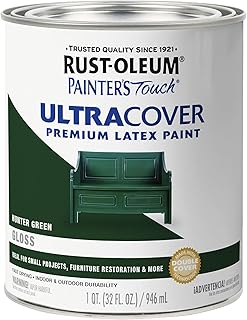
Best for: Indoor/outdoor furniture projects and surfaces including wood, metal, plaster, masonry, or unglazed ceramic. This water-based acrylic formula is low odor and resists chips, providing long-lasting protection. Coverage reaches up to 120 sq ft, with a dry-to-touch time of about 30 minutes, enabling quick project completion.
- Why selected: High versatility across surfaces and fast-drying for quick refreshes.
- Limitations: May require a clear top coat for high-wear areas.
ALL-IN-ONE Heirloom Traditions Crete

Best for: Interiors and exteriors on hard surfaces like walls, doors, cabinets, counters, and furniture. Claims to require no sanding, priming, or top coat, with low luster/velvet sheen suitable for furniture refinishing and broad surface coverage.
- Why selected: Convenience of a single-step product for multiple hard surfaces.
- Limitations: Finish may vary with lighting; test color in your space before large use.
Rust-Oleum Painter’s Touch Satin Hunt Club Green

Best for: Wood and metal surfaces needing a durable satin finish with fast drying. Like the gloss version, it’s multi-surface with a low-odor water-based acrylic formula and 120 sq ft coverage.
- Why selected: Satin finish offers a balanced sheen that hides imperfections better than gloss.
- Limitations: Satin may show brush marks on detailed surfaces; light sanding can help prep.
DWIL Matte Olive Green Furniture Paint

Best for: Cabinets, tables, dressers, and other furniture pieces where a low-luster look is preferred. The kit includes tools for a complete setup, and the paint is designed to adhere to wood without priming.
- Why selected: Complete tool set saves prep time and helps beginners achieve smoother results.
- Limitations: Non-primed application may require gentle surface sanding on very smooth or glossy substrates.
Rust-Oleum Chalked All-in-One Tate Green Spray

Best for: Quick furniture refresh projects and spray-on applications. Chalked All-in-One provides one-coat coverage with no primer, simplifying small to mid-size projects and indoor use.
- Why selected: Ideal for beginners seeking a simple, fast approach to updating pieces like nightstands or shelves.
- Limitations: Spray formats may require masking and ventilation; even coverage is essential for uniform results.
Buying Guide: How To Choose Green Furniture Paint
Finish and surface compatibility: Choose between gloss, satin, matte, or velvet sheens based on how much sheen you want and how much wear the piece gets. For high-traffic surfaces, a durable enamel or satin finish often performs best, while matte and chalky finishes suit decorative pieces.
Surface type and prep: Some products advertise “no priming” or “no sanding,” but most furniture projects benefit from light cleaning and a smooth, dry surface. Consider whether you need a full kit (brushes, rollers, and sealants) or just paint.
Interior vs exterior use: For indoor furniture, low-odor formulas are preferable. Exterior or semi-exterior items may benefit from outdoor-rated finishes with stronger UV resistance and chip protection.
Drying and recoat times: Short drying times allow faster turnaround, but ensure you follow the manufacturer’s guidance for recoat windows to avoid raised fibers or uneven patches.
Color testing: Consider using sample cards or a small test area to verify the green shade under your room’s lighting before committing to a large project.
FAQ
- Q: Can I paint over stained wood without sanding? A: Some paints claim no primer needed, but light abrasion and cleaning help adhesion and a smoother finish.
- Q: Which finish hides brush marks best? A: Matte or velvet/satin finishes tend to hide brush strokes better than high-gloss finishes.
- Q: How long before re-coating? A: Check product-specific guidance; many offer re-coat times within 1-2 hours for water-based paints.
- Q: Are water-based paints durable for furniture? A: Yes, especially products labeled for multi-surface use; consider a topcoat for high-traffic pieces.
- Q: Is spraying better than brushing? A: Sprays are convenient for small parts and intricate details; brushes provide control for larger surfaces.
- Q: How do I test color indoors? A: Apply a small patch on the furniture or a test board and observe under room lighting for 24 hours.