Answering the question you likely have: these hand sanders are well-suited for deck refinishing, sanding between deck boards, and smoothing rough patches before staining or sealing. The top picks in this guide cater to different needs, from compact detail work to larger surface prep. Best-for buyers include DIY homeowners tackling a porch or deck rail restoration, and hobbyists refinishing outdoor wood. The following table summarizes the five selected products for quick comparison.
| Product | Type | Best For | Why It Stands Out |
|---|---|---|---|
| SKIL 5” Random Orbital Sander SR211601 | Random Orbit | General deck sanding and smooth finishes | Strong motor, dust control, adjustable speed |
| SKIL Corded Multi-Function Detail Sander SR232301 | Detail Sander | Edges and tight corners on decks | Versatile with extra attachments and good dust control |
| BLACK+DECKER Detail Sander BDEMS600 | Detail Sander | Small gaps and intricate deck areas | Compact, comfortable grip, corded power |
| DEKOPRO 5″ Random Orbital Sander | Orbital Sander | Large deck surfaces | Multiple speeds, efficient dust system |
| HYCHIKA Detail Sander | Detail Sander | Tight spaces and precise finish work | Quiet, includes 12 sheets, efficient dust collection |
SKIL 5” Random Orbital Sander SR211601

Features include a powerful 2.8 amp motor delivering 13,000 orbits per minute for smooth deck sanding across various materials. The X-flow cyclonic dust container is easy to empty and helps keep work areas cleaner, while variable speed control allows precise power adjustment for different deck wood types. Best for general deck prep and face sanding where vibration and dust control are concerns.
Who this is best for: DIY homeowners tackling larger deck surfaces with standard boards. Why selected: strong motor and dust management suit routine outdoor refinishing tasks. Caution: Dust containment depends on reliable emptying of the transparent container; monitor the container during heavy dust periods.
SKIL Corded Multi-Function Detail Sander SR232301
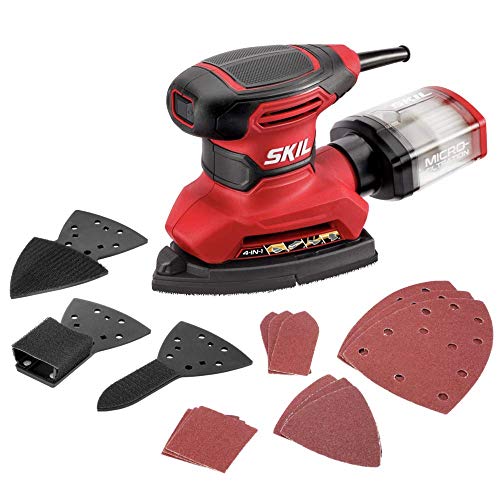
This 4-in-1 detail sander provides versatility for refinishing deck edges, railings, and tight corners. It features a 1.2 amp motor with 13,500 orbits per minute for smooth finishes. It comes with three additional detail attachments for fine finishing on large surfaces, edges, and contours. Best for: decks with detailed trim work and narrow gaps. Caution: The included attachments and dust filtration require routine changes to maintain performance.
BLACK+DECKER Detail Sander BDEMS600

Compact and corded, this detail sander emphasizes control with an ergonomic grip and compact design ideal for deck corners, rail finials, and tight board gaps. It provides consistent power for precision work in small spaces. Best for: finishing work in confined deck areas where larger sanders cannot reach. Caution: Smaller size may mean slower material removal on thick finishes compared to larger orbital units.
DEKOPRO 5″ Random Orbital Sander

Powered by a 2.5A motor with up to 14,000 RPM, this sander covers deck surfaces efficiently. It offers six variable speeds and 16 sanding discs (P60–P1000) for coarse to fine work, and a quick-change hook-and-loop disc system with a detachable dust bag to improve cleanup time. Best for: larger deck projects requiring faster material removal. Caution: Dust collection is dependent on the bag staying attached during use.
HYCHIKA Detail Sander

HYCHIKA offers a compact detail sander with a 14,000 orbits per minute rating and a dust collection system. It includes 12 sanding sheets (P80, P120, P240) and six-hole dust extraction compatibility, which helps keep the deck sanding area cleaner. Best for: precise work in constrained deck areas and quick material changes. Caution: For heavy stock removal, this model may require longer sanding sessions to achieve a smooth finish.
Buying Guide
What type of sander should I choose for a deck?
- Orbital sanders are versatile for large deck surfaces and general prep. They provide smooth finishes with balanced aggressive material removal.
- Detail sanders excel at edges, rails, and tight corners where bigger units can’t reach.
- Combination choices depend on deck size, edge work, and finish quality you need.
What features matter for outdoor deck sanding?
- Dust collection: A built-in bag or container minimizes cleanup and protects surrounding areas.
- Variable speed: Different woods and coatings benefit from adjustable RPMs to avoid burn marks.
- Disc size and pad type: 5″ discs cover more area; hook-and-loop systems enable quick disc changes.
Is corded or cordless better for deck work?
- Corded tools offer continuous power for longer sessions and are usually lighter in weight, which helps with fatigue during decks refinishing. Cordless options add mobility but may require battery management and have runtime limits.
How to choose between a detail sander and a random orbital sander?
- Use a random orbital sander for bulk deck prep and smoothing faces. Use a detail sander for edges, corners, and narrow spaces.
- For deck boards with many grooves, combine both tools to finish efficiently while preserving wood integrity.
FAQ
- What grit sequence is ideal for deck refinishing? Start with 60–80 grit for removing old finishes, then move to 120–150 grit for smoothing, and finish with 220 grit for a fine surface before staining or sealing.
- How important is dust collection when sanding outdoors? Dust control helps minimize debris and improves visibility, though outdoor airflow can still carry dust away.
- Can I use these sanders on pressure-treated wood? Yes, but avoid excessive heat and burn marks by using lower speeds and frequent check-ins.
- Should I seal the deck after sanding? Yes, post-sanding sealing or staining protects wood from moisture and UV damage and extends deck life.