Answering the common question for homeowners and contractors: which waterproofing paints work best on flat or low-slope roofs? This guide highlights five top Amazon picks designed to seal, flex, and protect flat and metal roofs. Each product is evaluated for best-for scenarios, ease of application, and potential limits. The buyer profile for these products ranges from DIY homeowners repairing small leaks to contractors seeking durable, long-term membranes. The summary table below helps compare core attributes at a glance.
| Product | Best For | Key Benefit |
|---|---|---|
| Liquid Rubber Color Roof Sealant | Flat & low-slope roofs, professionals | Highly flexible membrane with up to 900% elongation |
| 100% Silicone Roof Coating (RV & Flat Roofs) | Long-term UV resistance, minimal coats | Thick, durable silicone membrane, no primer needed in many cases |
| Ames Maximum Stretch | Large-area repairs, high stretch needs | Up to 650% elasticity for movement |
| Liquid Rubber Waterproof Sealant (Roof & Gutter) | DIY leaks, gutters, flat surfaces | Flexible elastomeric coating for roof and gutters |
| Gardner-Gibson Sta-Kool Turbo-Dri | White reflective coating, RV use | 15-year performance with reflective finish |
Liquid Rubber Color Roof Sealant — Flat & Metal Roofs
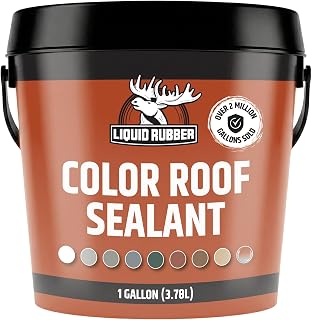
Brand: Liquid Rubber Store. This professional-grade elastomeric coating cures into a durable, rubber-like membrane with up to 900% elongation. It applies like paint and builds a seamless waterproof layer on clean, dry roof surfaces. Best for frequent roof movement and low-slope or metal roofs that need flexible protection. A key limitation is that multiple heavy coats are typically required to achieve full waterproofing, with full cure taking about 24–48 hours. Choose this for long-term flexibility and crack resistance on flat roofs.
100% Silicone Roof Coating for RV & Flat Roofs

Brand: Countryman Coatings Store. This coating uses a high-solids, 100% silicone formula designed to resist ponding water, UV exposure, and extreme weather while remaining flexible. Benefits include requiring no primer for many applications and forming a longer-lasting waterproof membrane with fewer coats. It excels on RV and flat roofs where UV resistance and durability matter most. Limitation: some substrates may still require surface prep and priming for optimal adhesion in challenging conditions.
Ames Maximum Stretch

Brand: Ames. This product provides up to 650% elasticity, supporting roof expansion and contraction without cracking. Best for larger repair jobs or roofs with notable movement. The formulation is designed to be applied as a sealer membrane that remains flexible over time. Limitation: the packaging indicates a larger volume; ensure proper surface preparation and ventilation during application.
Liquid Rubber Waterproof Sealant

Brand: Liquid Rubber Store. This product targets DIY leak repairs on flat surfaces, gutters, and low-slope areas. It offers a flexible elastomeric membrane suitable for coating rooftops and adjacent structures. Best for quick fixes and small-to-medium leaks. Limitation: data notes the need for multiple coats and proper surface preparation to ensure adhesion and long-term performance.
Gardner-Gibson Sta-Kool Turbo-Dri

Brand: Gardner-Gibson. Sta-Kool Turbo-Dri offers a reflective white finish with flexible acrylic components. Best for RVs and roofs where a cool, reflective surface helps reduce heat gain. It provides a durable, white coating that reflects sunlight. Limitation: as an acrylic-based coating, prolonged UV exposure can gradually affect performance; ensure proper surface prep for adhesion on varied substrates.
Buying Guide
What should you consider before buying flat roof waterproofing paint?
- Roof type and substrate: Metal, concrete, EPDM, or SPF membranes may affect adhesion. Look for products labeled for your roof type or with no-primer requirements where applicable.
- Flexibility and movement: Flat roofs experience expansion and contraction. Choose elastomeric or silicone formulas with high elongation if movement is expected.
- UV and ponding resistance: For sunny climates or areas with standing water, prioritize UV-stable silicone or elastomeric coatings with ponding resistance.
- Application and coverage: Consider products that apply by brush, roller, or spray, and note coat thickness requirements to build a full membrane.
- Maintenance and longevity: Some coatings offer extended service life or reflectivity; weigh the benefits against maintenance needs over time.
Frequently Asked Questions
- Q: Do these coatings require a primer? A: Some 100% silicone products may bond to prepared substrates without primer, but many coatings benefit from a clean, dry surface and may require primer on certain substrates.
- Q: Can I use these on metal roofs? A: Yes, several products are designed for flat or low-slope metal surfaces, offering flexible, waterproof membranes.
- Q: How long does curing take? A: Full cure commonly occurs within 24–48 hours, depending on temperature, humidity, and coat thickness.
- Q: Will these coatings stop leaks immediately? A: They create a continuous membrane to reduce water intrusion, but existing leaks may require patching and surface prep for optimal results.
- Q: Are reflective coatings better for heat control? A: Reflective white finishes can reduce heat absorption and surface temperatures, beneficial for RVs and sun-exposed roofs.
- Q: How many coats are needed? A: Construction guides often specify multiple coats to build a reliable waterproof membrane; follow the product’s instructions for best results.