Direct answer: For protecting metal from rust and corrosion, these five products provide strong rust conversion, inhibitor action, and durable coatings. They’re best suited for automotive, marine, industrial, and outdoor equipment maintenance. This guide highlights which option is best for your project, why it’s chosen, and practical limits to consider.
| Product | Brand | Best For |
|---|---|---|
| Rust-Oleum 248658 Stops Rust Reformer Spray Paint | Rust-Oleum | Immediate rust conversion and paint-ready surface |
| WD-40 Specialist Corrosion Inhibitor | WD-40 Specialist | Preventive protection, indoor/outdoor environments |
| Rust Converter & Metal Primer (LISRUX) 141 Fl Oz | LISRUX | Heavy-duty rust conversion with heat resistance |
| Corroseal Rust Converter & Metal Primer | Corroseal | One-step rust conversion and priming |
| 2-in-1 Rust Converter & Metal Primer (MuzeFansi) 35 oz | MuzeFansi | All-in-one rust conversion and priming for various metals |
Below are detailed product sections to help you compare features, benefits, and limitations so you can choose confidently.
Rust-Oleum 248658 Stops Rust Reformer Spray Paint

Product focus: A rust reformer that converts rust on metal into a paintable surface, then seals for future rust prevention. The oil-based formula bonds with the rusted surface and accepts topcoats after curing.
- Best for quick transformation of rusty metal before painting.
- Clear advantage when you need an immediately paintable, rust-stabilized surface.
- Limitations: As an reformer and primer, it requires a topcoat for full outdoor protection.
WD-40 Specialist Corrosion Inhibitor

Product focus: A long-lasting anti-rust spray that coats metal parts to block air and moisture. It’s designed for preventative maintenance and environments prone to humidity, salt, or temperature extremes.
- Best for ongoing protection and areas with exposure to moisture and salt spray.
- Better for indoor use or as part of regular maintenance routines.
- Limitations: Not a paint; may require reapplication and can have limited film thickness compared to paints.
Rust Converter & Metal Primer (LISRUX) 141 Fl Oz

Product focus: A one-component rust converter that also acts as a metal primer with heat resistance up to 350°F. It seals out water and air to slow oxidation and can be used on automotive, machinery, marine, and industrial surfaces.
- Best for a large-scale coating project where rust conversion plus priming is desired in one step.
- Better for metal parts exposed to heat and outdoor conditions.
- Limitations: Water-based formulation may require proper ventilation and curing time before topcoating.
Corroseal Rust Converter & Metal Primer
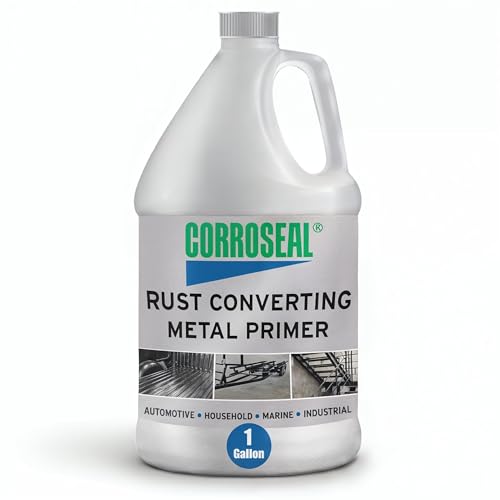
Product focus: Water-based rust converter that primes and converts rust in one step, forming a non-flammable, non-corrosive coating. Suitable for cars, trucks, trailers, marine, and industrial equipment.
- Best for environments where minimizing flammability and simplifying steps is important.
- Better for DIY projects and small-to-medium industrial tasks.
- Limitations: May require follow-up topcoat for additional protection depending on exposure.
2-in-1 Rust Converter & Metal Primer – MuzeFansi

Product focus: All-in-one rust converter and primer designed to stop rust and seal out moisture and air. Claims heat and UV resistance, suitable for automotive, marine, industrial, and outdoor use.
- Best for projects needing both rust conversion and immediate primer in one step.
- Better for wide variety of metals and outdoor exposure.
- Limitations: Real-world performance depends on surface condition and proper curing time before topcoating.
Buying Guide: Key Purchase Considerations
What should you consider when selecting anti-corrosion paint or converter for metal?
- Surface condition: If you have bare rust, a rust converter or reformer helps create a paintable base. For lightly corroded surfaces, a primer-plus-paint approach may suffice.
- Environment: Outdoor marine or coastal environments demand UV resistance, moisture barriers, and long-lasting protection. Indoor environments may prioritize ease of use and odor control.
- Application method: Spray products offer fast coverage, while brush-on or roller-applied coatings can be thicker and longer-lasting.
- Heat exposure: Look for coatings with heat resistance if the metal will experience high temperatures, such as engine bays or exhaust areas.
- Layering: Some products are designed as one-step rust converters and primers, while others require a separate topcoat for full protection.
- Safety and cleanup: Water-based formulas clean up with soap and water, while oil-based products may require solvents and ventilation.
FAQ
- Q: Can I use rust converter directly on painted metal? A: Rust converters typically work best on rusted or flaky surfaces. It’s often recommended to remove loose coatings for better adhesion.
- Q: Do rust inhibitors prevent rust indefinitely? A: They slow or halt oxidation but require proper maintenance and reapplication in harsh environments.
- Q: Is a topcoat always necessary after a rust converter? A: Not always, but for exterior or high-wear applications, a topcoat improves durability and UV resistance.
- Q: Which product is best for marine use? A: Look for products with water resistance and UV stability; Corroseal and CorrosionX are commonly chosen for harsh outdoor or marine settings.
- Q: How long should I wait before topcoating after applying a rust reformer? A: Dry or tack-free times vary by product; follow the manufacturer’s guidelines, typically within 20-40 minutes for tack-free and 24 hours before topcoating in some formulations.
- Q: Are these products flammable? A: Some solvent-based coatings are flammable; check the label for ventilation and safety guidance.