The best airless paint sprayer for interior walls speeds up painting while delivering a smooth, even finish. This guide highlights five top options, explaining who each is best for, what to expect, and key trade-offs. Ideal buyers range from DIY homeowners tackling large interior surfaces to hobbyists painting furniture or fences near indoor spaces. Use the table below to compare core strengths at a glance.
| Product | Brand | Key Benefit |
|---|---|---|
| WORKPRO 700W Airless Paint Sprayer | WORKPRO | High pressure, thinning-free, great for fast interior coverage |
| VEVOR 750W Stand Airless Paint Sprayer | VEVOR | Powerful motor, high flow, with extension options for hard-to-reach areas |
| InoKraft MaXpray M1 | InoKraft | High efficiency, thinning-free for latex and stain, beginner-friendly |
| HomeRight Super Finish Max HVLP | HomeRight | HVLP design for smaller indoor projects with versatile spray patterns |
| Graco Magnum X7 Cart | Graco | Direct-from-bucket spraying, robust for larger interior jobs |
WORKPRO 700W Airless Paint Sprayer

Best for: DIY homeowners painting large interior walls quickly. The 700W motor delivers up to 2900 PSI and a 0.317 GPM flow, enabling fast coverage on broad surfaces. No thinning is required, which simplifies setup and maintenance. The adjustable pressure helps tailor results to wall textures and coatings, improving control and reducing waste. A potential limitation is that setup and cleanup can be more involved than smaller handheld sprayers.
VEVOR 750W Stand Airless Paint Sprayer

Best for: medium to large interior projects where you want speed with reach. This stand model offers up to 3000 PSI and a 1.2 LPM flow rate, making it significantly faster than traditional rollers and brushes. The stand design simplifies operation and cleaning, and the extension pole supports high or ground-level work. A caution: heavier setup may require more storage space and a dedicated power source.
InoKraft MaXpray M1

Best for: beginners seeking a thinning-free solution for latex and stain on interior walls and exterior surfaces. The MaXpray M1 hits up to 3000 PSI with a 0.29 GPM flow, enabling rapid, even coverage. It includes a spray gun kit and a 12″ tip extension for reaching high areas. Clean-up is designed to be straightforward, with guidance focused on quick setup. Limitation: may still require some initial learning for tip selection and oscillation techniques.
VEVOR Stand Airless Paint Sprayer

Best for: homeowners needing a robust, stand-based sprayer for walls, furniture, and fences. It runs at up to 3000 PSI with a 25 ft hose, enabling flexible layouts and consistent atomization. The device is designed to handle water-based and oil-based coatings, including latex and stains. A caution: longer hoses can increase line resistance, so nozzle selection matters for achieving uniform spray patterns.
HomeRight Super Finish Max HVLP
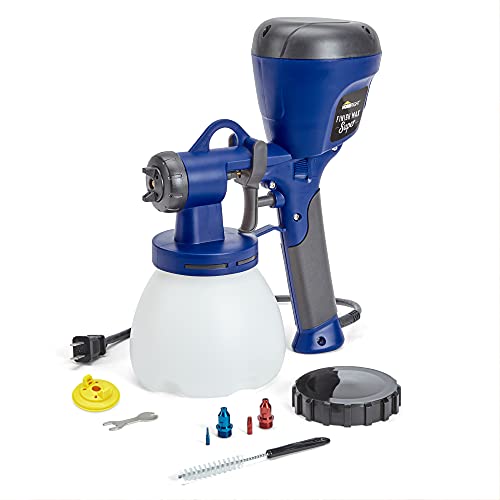
Best for: interior projects that require precise control and a fine finish on smaller surfaces. This HVLP sprayer offers adjustable air cap directions (horizontal, vertical, round) and a material flow control, ideal for cabinets, furniture, and trim. It handles chalk-type paints and acrylics well. Limitation: HVLP sprayers typically require thinning or careful viscosity control for thicker coatings, which may affect finish if not managed properly.
Graco Magnum X7 Cart

Best for: larger interior jobs where spraying directly from a paint bucket is desirable. The Graco Magnum X7 offers fully adjustable paint flow and a stainless steel piston pump for unthinned paint spraying at high pressure. The cart design improves mobility around a painting site. A caution: this model might be heavier and overkill for small rooms or detailed trim work.
Buying Guide
Key considerations when choosing an airless sprayer for interior walls include power, pressure, flow rate, and ease of cleaning. For big rooms, prioritize higher PSI and a stand or cart with a long hose to minimize moving the unit. If you’re painting furniture, cabinets, or trim, look for sprayers with fine atomization and adjustable patterns. Consider whether you plan to spray water-based latex, oil-based coatings, or stains, and confirm thinning requirements with the included tips and accessories.
- Power and speed: Higher PSI and GPM translate to faster coverage, but can increase overspray if not controlled.
- Ease of use: Models with detachable pump bodies, cleaning kits, and quick-connect tips save time on cleanup.
- Versatility: A stand or cart is helpful for large rooms; HVLP is better for fine finishes on furniture and trim.
- Coating compatibility: Ensure the sprayer supports the coatings you’ll use (latex, oil-based, stains) and whether thinning is required.
- Reach and setup: Long hoses and extension poles reduce bending and re-positioning; plan for ventilation and mess control.
FAQ
- What is the main advantage of an airless sprayer for interior walls?
– It covers large areas quickly with a smooth, even finish and reduced brush marks. - Do I need to thin paint for airless sprayers?
– Many models are thinning-free for latex, but some coatings may require slight thinning depending on the tip and pressure. - Is a stand or cart beneficial for wall painting?
– Yes, it improves stability, allows higher reach, and makes cleanup easier. - Can these sprayers handle walls with intricate details?
– Yes, but HVLP sprayers with adjustable spray patterns are often better for corners and trim; use smaller tips and slower passes. - Which sprayer is best for beginners?
– Models with guided setup, included cleaning kits, and easy disassembly are typically beginner-friendly. - What maintenance helps longevity?
– Clean the system after use, flush with water or solvent per coating, and inspect seals and tips for wear.